2 Gravitational Wave Generation
We start by looking at where and how Gravitational Wave (GW) are generated. We will see that General Relativity (GR) predicts the existence of GW and we will explore under what conditions they are observable.
2.1 GW
To this day, the most fundamental theory of gravity is GR due to Einstein. It formulates spacetime as a Riemannian manifold with curvature, determined by mass distribution. This curvature is encoded in the metric \(\texttip{\texttip{\texttip{g}{metric tensor}{}_{{\mu\nu}}}{covariant mathbftor component}}{covariant metric tensor component}\). Objects then move in this deformed spacetime following Equation of Motion (EOM) written in terms of \(\texttip{\texttip{\texttip{g}{metric tensor}{}_{{\mu\nu}}}{covariant mathbftor component}}{covariant metric tensor component}\). Interaction is thus caused by the dependence of \(\texttip{\texttip{\texttip{g}{metric tensor}{}_{{\mu\nu}}}{covariant mathbftor component}}{covariant metric tensor component}\) on mass distribution, which itself evolves through \(\texttip{\texttip{\texttip{g}{metric tensor}{}_{{\mu\nu}}}{covariant mathbftor component}}{covariant metric tensor component}\). The physical laws that governs the interaction between mass and curvature are manifested in Einstein’s field equations,
\[ \boxed{\texttip{\texttip{\texttip{R}{Ricci tensor}{}_{{\mu\nu}}}{covariant mathbftor component}}{covariant Ricci tensor component}-\frac{\texttip{\texttip{\texttip{g}{metric tensor}{}_{{\mu\nu}}}{covariant mathbftor component}}{covariant metric tensor component}}{2} \texttip{R}{Ricci scalar}+\texttip{\Lambda}{cosmological constant}\texttip{\texttip{\texttip{g}{metric tensor}{}_{{\mu\nu}}}{covariant mathbftor component}}{covariant metric tensor component}=-8 \pi \texttip{G}{gravitational constant}\texttip{\texttip{\texttip{T}{Stress-Energy tensor, or energy-momentum tensor}{}_{{\mu\nu}}}{covariant mathbftor component}}{covariant Stress-Energy tensor component}} . \tag{2.1}\]
The Left-Hand Side (LHS) of this equation contains several objects that only depend on the metric \(\texttip{\texttip{\texttip{g}{metric tensor}{}_{{\mu\nu}}}{covariant mathbftor component}}{covariant metric tensor component}\). \(\texttip{\texttip{\texttip{R}{Ricci tensor}{}_{{\mu\nu}}}{covariant mathbftor component}}{covariant Ricci tensor component}\) is the Ricci tensor1, a contraction of the Riemann curvature tensor \(\texttip{\texttip{R}{Riemann tensor}^{\beta}_{\phantom{\beta}\mu\nu\rho}}{Riemann Tensor tensor component}\). The Riemann tensor2 encodes the curvature of spacetime, in terms of the non-commutativity of covariant derivatives. When they do, it means that they have collapsed to regular derivatives, and thus the Levi-civita connection3 must have vanished. This is only possible if the metric is flat, \(\texttip{\texttip{\texttip{g}{metric tensor}{}_{{\mu\nu}}}{covariant mathbftor component}}{covariant metric tensor component}=\texttip{\texttip{\texttip{\eta}{Minkoski metric tensor +---}{}_{{\mu\nu}}}{covariant mathbftor component}}{covariant Minkoski metric components +---}\). The Riemann curvature tensor is exclusively composed of the metric, its first, second derivatives, and it is linear in the second derivative of the metric. In fact, it is the only possible tensor of this form. The second term on the LHS is the Ricci scalar, a further contraction of the Ricci Tensor: \(\texttip{R}{Ricci scalar}= \texttip{\texttip{\texttip{g}{metric tensor}{}^{{\mu\nu}}}{contravariant mathbftor component}}{contravariant metric tensor component}\texttip{\texttip{\texttip{R}{Ricci tensor}{}_{{\mu\nu}}}{covariant mathbftor component}}{covariant Ricci tensor component}\). The final term on the LHS is just a proportional constant factor of the metric, \(\texttip{\Lambda}{cosmological constant}\), called the cosmological constant. It can be measured and has a low known upper bound. It is in part responsible for the expansion of the universe.
1 The Ricci Tensor is given by: \[ \texttip{\texttip{\texttip{R}{Ricci tensor}{}_{{\mu\nu}}}{covariant mathbftor component}}{covariant Ricci tensor component}\coloneq \texttip{\texttip{R}{Riemann tensor}^{\alpha}_{\phantom{\alpha}\mu\alpha\nu}}{Riemann Tensor tensor component}=\texttip{\texttip{\texttip{g}{metric tensor}{}^{\alpha\beta}}{contravariant mathbftor component}}{contravariant metric tensor component}\texttip{\texttip{\texttip{R}{Riemann tensor}{}^{\alpha\mu\beta\nu}}{contravariant mathbftor component}}{fully covariant Riemann tensor component} \]
2 The Riemann Tensor is given by: \[ \texttip{\texttip{R}{Riemann tensor}^{\beta}_{\phantom{\beta}\mu\nu\rho}}{Riemann Tensor tensor component}=\mathtip{\Gamma^{\beta}_{\phantom{\beta}\mu\nu}}{\text{Levi-Civita Connection: }\Gamma^{\beta}_{\phantom{\beta}\mu\nu}= \frac{1}{2} \texttip{\texttip{\texttip{g}{metric tensor}{}^{\beta \rho}}{contravariant mathbftor component}}{contravariant metric tensor component} \Big\{ \texttip{\texttip{\texttip{g}{metric tensor}{}_{\rho \beta}}{covariant mathbftor component}}{covariant metric tensor component}\texttip{{}_{,\mu}}{Partial derivative} +\texttip{\texttip{\texttip{g}{metric tensor}{}_{\rho \mu}}{covariant mathbftor component}}{covariant metric tensor component}\texttip{{}_{,\beta}}{Partial derivative} -\texttip{\texttip{\texttip{g}{metric tensor}{}_{\mu \beta}}{covariant mathbftor component}}{covariant metric tensor component}\texttip{{}_{,\rho}}{Partial derivative} \Big\} }\texttip{{}_{,\rho}}{Partial derivative} - \mathtip{\Gamma^{\beta}_{\phantom{\beta}\mu\rho}}{\text{Levi-Civita Connection: }\Gamma^{\beta}_{\phantom{\beta}\mu\rho}= \frac{1}{2} \texttip{\texttip{\texttip{g}{metric tensor}{}^{\beta \rho}}{contravariant mathbftor component}}{contravariant metric tensor component} \Big\{ \texttip{\texttip{\texttip{g}{metric tensor}{}_{\rho \beta}}{covariant mathbftor component}}{covariant metric tensor component}\texttip{{}_{,\mu}}{Partial derivative} +\texttip{\texttip{\texttip{g}{metric tensor}{}_{\rho \mu}}{covariant mathbftor component}}{covariant metric tensor component}\texttip{{}_{,\beta}}{Partial derivative} -\texttip{\texttip{\texttip{g}{metric tensor}{}_{\mu \beta}}{covariant mathbftor component}}{covariant metric tensor component}\texttip{{}_{,\rho}}{Partial derivative} \Big\} }\texttip{{}_{,\nu}}{Partial derivative} - \mathtip{\Gamma^{\alpha}_{\phantom{\alpha}\mu\rho}}{\text{Levi-Civita Connection: }\Gamma^{\alpha}_{\phantom{\alpha}\mu\rho}= \frac{1}{2} \texttip{\texttip{\texttip{g}{metric tensor}{}^{\alpha \rho}}{contravariant mathbftor component}}{contravariant metric tensor component} \Big\{ \texttip{\texttip{\texttip{g}{metric tensor}{}_{\rho \alpha}}{covariant mathbftor component}}{covariant metric tensor component}\texttip{{}_{,\mu}}{Partial derivative} +\texttip{\texttip{\texttip{g}{metric tensor}{}_{\rho \mu}}{covariant mathbftor component}}{covariant metric tensor component}\texttip{{}_{,\alpha}}{Partial derivative} -\texttip{\texttip{\texttip{g}{metric tensor}{}_{\mu \alpha}}{covariant mathbftor component}}{covariant metric tensor component}\texttip{{}_{,\rho}}{Partial derivative} \Big\} }\mathtip{\Gamma^{\beta}_{\phantom{\beta}\alpha\nu}}{\text{Levi-Civita Connection: }\Gamma^{\beta}_{\phantom{\beta}\alpha\nu}= \frac{1}{2} \texttip{\texttip{\texttip{g}{metric tensor}{}^{\beta \rho}}{contravariant mathbftor component}}{contravariant metric tensor component} \Big\{ \texttip{\texttip{\texttip{g}{metric tensor}{}_{\rho \beta}}{covariant mathbftor component}}{covariant metric tensor component}\texttip{{}_{,\alpha}}{Partial derivative} +\texttip{\texttip{\texttip{g}{metric tensor}{}_{\rho \alpha}}{covariant mathbftor component}}{covariant metric tensor component}\texttip{{}_{,\beta}}{Partial derivative} -\texttip{\texttip{\texttip{g}{metric tensor}{}_{\alpha \beta}}{covariant mathbftor component}}{covariant metric tensor component}\texttip{{}_{,\rho}}{Partial derivative} \Big\} }+\mathtip{\Gamma^{\alpha}_{\phantom{\alpha}\mu\nu}}{\text{Levi-Civita Connection: }\Gamma^{\alpha}_{\phantom{\alpha}\mu\nu}= \frac{1}{2} \texttip{\texttip{\texttip{g}{metric tensor}{}^{\alpha \rho}}{contravariant mathbftor component}}{contravariant metric tensor component} \Big\{ \texttip{\texttip{\texttip{g}{metric tensor}{}_{\rho \alpha}}{covariant mathbftor component}}{covariant metric tensor component}\texttip{{}_{,\mu}}{Partial derivative} +\texttip{\texttip{\texttip{g}{metric tensor}{}_{\rho \mu}}{covariant mathbftor component}}{covariant metric tensor component}\texttip{{}_{,\alpha}}{Partial derivative} -\texttip{\texttip{\texttip{g}{metric tensor}{}_{\mu \alpha}}{covariant mathbftor component}}{covariant metric tensor component}\texttip{{}_{,\rho}}{Partial derivative} \Big\} }\mathtip{\Gamma^{\beta}_{\phantom{\beta}\alpha\rho}}{\text{Levi-Civita Connection: }\Gamma^{\beta}_{\phantom{\beta}\alpha\rho}= \frac{1}{2} \texttip{\texttip{\texttip{g}{metric tensor}{}^{\beta \rho}}{contravariant mathbftor component}}{contravariant metric tensor component} \Big\{ \texttip{\texttip{\texttip{g}{metric tensor}{}_{\rho \beta}}{covariant mathbftor component}}{covariant metric tensor component}\texttip{{}_{,\alpha}}{Partial derivative} +\texttip{\texttip{\texttip{g}{metric tensor}{}_{\rho \alpha}}{covariant mathbftor component}}{covariant metric tensor component}\texttip{{}_{,\beta}}{Partial derivative} -\texttip{\texttip{\texttip{g}{metric tensor}{}_{\alpha \beta}}{covariant mathbftor component}}{covariant metric tensor component}\texttip{{}_{,\rho}}{Partial derivative} \Big\} }. \]
3 The Levi-Civita Connection is given by: \[\mathtip{\Gamma^{\alpha}_{\phantom{\alpha}\mu\nu}}{\text{Levi-Civita Connection: }\Gamma^{\alpha}_{\phantom{\alpha}\mu\nu}= \frac{1}{2} \texttip{\texttip{\texttip{g}{metric tensor}{}^{\alpha \rho}}{contravariant mathbftor component}}{contravariant metric tensor component} \Big\{ \texttip{\texttip{\texttip{g}{metric tensor}{}_{\rho \alpha}}{covariant mathbftor component}}{covariant metric tensor component}\texttip{{}_{,\mu}}{Partial derivative} +\texttip{\texttip{\texttip{g}{metric tensor}{}_{\rho \mu}}{covariant mathbftor component}}{covariant metric tensor component}\texttip{{}_{,\alpha}}{Partial derivative} -\texttip{\texttip{\texttip{g}{metric tensor}{}_{\mu \alpha}}{covariant mathbftor component}}{covariant metric tensor component}\texttip{{}_{,\rho}}{Partial derivative} \Big\} }= \frac{1}{2} \texttip{\texttip{\texttip{g}{metric tensor}{}^{\alpha \rho}}{contravariant mathbftor component}}{contravariant metric tensor component} \Big\{ \texttip{\texttip{\texttip{g}{metric tensor}{}_{\rho \nu}}{covariant mathbftor component}}{covariant metric tensor component}\texttip{{}_{,\mu}}{Partial derivative} + \texttip{\texttip{\texttip{g}{metric tensor}{}_{\rho \mu}}{covariant mathbftor component}}{covariant metric tensor component}\texttip{{}_{,\nu}}{Partial derivative} - \texttip{\texttip{\texttip{g}{metric tensor}{}_{{\mu\nu}}}{covariant mathbftor component}}{covariant metric tensor component}\texttip{{}_{,\rho}}{Partial derivative} \Big\} \]
The Right-Hand Side (RHS) of eq. 2.1 encodes the distribution of mass and energy in the universe, through the stress-energy tensor \(\texttip{\texttip{\texttip{T}{Stress-Energy tensor, or energy-momentum tensor}{}_{{\mu\nu}}}{covariant mathbftor component}}{covariant Stress-Energy tensor component}\), which depends on the dynamical properties of the system. It is further multiplied by the Gravitational constant \(\texttip{G}{gravitational constant}\). In empty space, \(\texttip{\texttip{\texttip{T}{Stress-Energy tensor, or energy-momentum tensor}{}_{{\mu\nu}}}{covariant mathbftor component}}{covariant Stress-Energy tensor component}\) is zero.
Equation 2.1 can be recast in a form where the Ricci scalar has been substituted by the trace of the stress-energy tensor,
\[ \boxed{\texttip{\texttip{\texttip{R}{Ricci tensor}{}_{{\mu\nu}}}{covariant mathbftor component}}{covariant Ricci tensor component}=-8 \pi \texttip{G}{gravitational constant}\left(\texttip{\texttip{\texttip{T}{Stress-Energy tensor, or energy-momentum tensor}{}_{{\mu\nu}}}{covariant mathbftor component}}{covariant Stress-Energy tensor component}-\texttip{\texttip{T}{Stress-Energy tensor, or energy-momentum tensor}^{\alpha}_{\phantom{\alpha}\alpha}}{Stress-Energy tensor trace}\frac{\texttip{\texttip{\texttip{g}{metric tensor}{}_{{\mu\nu}}}{covariant mathbftor component}}{covariant metric tensor component}}{2}\right)+\texttip{\Lambda}{cosmological constant}\texttip{\texttip{\texttip{g}{metric tensor}{}_{{\mu\nu}}}{covariant mathbftor component}}{covariant metric tensor component}} \tag{2.2}\]
Both eq. 2.1 & eq. 2.2 with \(\texttip{\Lambda}{cosmological constant}=0\) admit wave solutions. In order to see this, let us look at these equations in the weak field approximation. We take the metric to be a small perturbation around the Minkowskian background,
\[ \texttip{\texttip{\texttip{g}{metric tensor}{}_{{\mu\nu}}}{covariant mathbftor component}}{covariant metric tensor component}= \texttip{\texttip{\texttip{\eta}{Minkoski metric tensor +---}{}_{{\mu\nu}}}{covariant mathbftor component}}{covariant Minkoski metric components +---}+ \texttip{\texttip{\texttip{h}{weak metric tensor}{}_{{\mu\nu}}}{covariant mathbftor component}}{weak covariant metric tensor component}, \tag{2.3}\]
where \(\texttip{\texttip{\texttip{h}{weak metric tensor}{}_{{\mu\nu}}}{covariant mathbftor component}}{weak covariant metric tensor component}\) is the expansion parameter (thus considered small). Note that if we restrict ourselves to first order in \(\texttip{\texttip{\texttip{h}{weak metric tensor}{}_{{\mu\nu}}}{covariant mathbftor component}}{weak covariant metric tensor component}\) then all raising and lowering of indices is done with \(\texttip{\texttip{\texttip{\eta}{Minkoski metric tensor +---}{}_{{\mu\nu}}}{covariant mathbftor component}}{covariant Minkoski metric components +---}\). Since the LHS of eq. 2.1 is composed of the Ricci tensor and scalar, let us see how these behave in the weak approximation. Both are in fact made up of Levi-Civita connections, which to first order in \(\texttip{\texttip{\texttip{h}{weak metric tensor}{}_{{\mu\nu}}}{covariant mathbftor component}}{weak covariant metric tensor component}\) is given by: \[ \mathtip{\Gamma^{\alpha}_{\phantom{\alpha}\mu\nu}}{\text{Levi-Civita Connection: }\Gamma^{\alpha}_{\phantom{\alpha}\mu\nu}= \frac{1}{2} \texttip{\texttip{\texttip{g}{metric tensor}{}^{\alpha \rho}}{contravariant mathbftor component}}{contravariant metric tensor component} \Big\{ \texttip{\texttip{\texttip{g}{metric tensor}{}_{\rho \alpha}}{covariant mathbftor component}}{covariant metric tensor component}\texttip{{}_{,\mu}}{Partial derivative} +\texttip{\texttip{\texttip{g}{metric tensor}{}_{\rho \mu}}{covariant mathbftor component}}{covariant metric tensor component}\texttip{{}_{,\alpha}}{Partial derivative} -\texttip{\texttip{\texttip{g}{metric tensor}{}_{\mu \alpha}}{covariant mathbftor component}}{covariant metric tensor component}\texttip{{}_{,\rho}}{Partial derivative} \Big\} } = \frac{1}{2} \texttip{\texttip{\texttip{\eta}{Minkoski metric tensor +---}{}^{\alpha \rho}}{contravariant mathbftor component}}{contravariant Minkoski metric components +---} \Big\{ \texttip{\texttip{\texttip{h}{weak metric tensor}{}_{\rho \nu}}{covariant mathbftor component}}{weak covariant metric tensor component}\texttip{{}_{,\mu}}{Partial derivative} + \texttip{\texttip{\texttip{h}{weak metric tensor}{}_{\rho \mu}}{covariant mathbftor component}}{weak covariant metric tensor component}\texttip{{}_{,\nu}}{Partial derivative} - \texttip{\texttip{\texttip{h}{weak metric tensor}{}_{{\mu\nu}}}{covariant mathbftor component}}{weak covariant metric tensor component}\texttip{{}_{,\rho}}{Partial derivative} \Big\} + \mathcal{O}(h^{2})\quad . \tag{2.4}\]
Plugging eq. 2.4 into the definition of the Ricci tensor we see that the terms with products of the connection vanish, and we are left with the derivative terms:
\[ \texttip{\texttip{\texttip{R}{Ricci tensor}{}_{{\mu\nu}}}{covariant mathbftor component}}{covariant Ricci tensor component}= \frac{\texttip{\texttip{\texttip{\eta}{Minkoski metric tensor +---}{}^{\alpha\rho}}{contravariant mathbftor component}}{contravariant Minkoski metric components +---}}{2}\left[ \texttip{\texttip{\texttip{h}{weak metric tensor}{}_{\rho\alpha}}{covariant mathbftor component}}{weak covariant metric tensor component}\texttip{{}_{,\mu\nu}}{Partial derivative} + \texttip{\texttip{\texttip{h}{weak metric tensor}{}_{{\mu\nu}}}{covariant mathbftor component}}{weak covariant metric tensor component}\texttip{{}_{,\rho\alpha}}{Partial derivative} - \texttip{\texttip{\texttip{h}{weak metric tensor}{}_{\mu\alpha}}{covariant mathbftor component}}{weak covariant metric tensor component}\texttip{{}_{,\rho\nu}}{Partial derivative} - \texttip{\texttip{\texttip{h}{weak metric tensor}{}_{\nu\rho}}{covariant mathbftor component}}{weak covariant metric tensor component}\texttip{{}_{,\mu\alpha}}{Partial derivative} \right] + \mathcal{O}(h^2)=\texttip{\texttip{\texttip{R^{(1)}}{linearized Ricci tensor}{}_{{\mu\nu}}}{covariant mathbftor component}}{covariant linearized Ricci tensor component}+ \mathcal{O}(h^2) \tag{2.5}\]
The linearized Ricci scalar is then just \(\texttip{R^{(1)}}{linearized Ricci scalar}=\texttip{\texttip{\texttip{\eta}{Minkoski metric tensor +---}{}^{{\mu\nu}}}{contravariant mathbftor component}}{contravariant Minkoski metric components +---}\texttip{\texttip{\texttip{R^{(1)}}{linearized Ricci tensor}{}_{{\mu\nu}}}{covariant mathbftor component}}{covariant linearized Ricci tensor component}\). The symmetry of the Einstein Field Equations (EFE) under general diffeomorphisms implies the existence of gauge freedom. In particular, eq. 2.1, admits an infinite number of solutions, and in fact we can map a solution into another by changing coordinates in such a way that the equation isn’t affected. To fix this ambiguity we choose a coordinate system (‘gauge choice’) by imposing the harmonic coordinate conditions:
\[ \texttip{\texttip{\texttip{g}{metric tensor}{}^{\alpha\beta}}{contravariant mathbftor component}}{contravariant metric tensor component}\mathtip{\Gamma^{\mu}_{\phantom{\mu}\alpha\beta}}{\text{Levi-Civita Connection: }\Gamma^{\mu}_{\phantom{\mu}\alpha\beta}= \frac{1}{2} \texttip{\texttip{\texttip{g}{metric tensor}{}^{\mu \rho}}{contravariant mathbftor component}}{contravariant metric tensor component} \Big\{ \texttip{\texttip{\texttip{g}{metric tensor}{}_{\rho \mu}}{covariant mathbftor component}}{covariant metric tensor component}\texttip{{}_{,\alpha}}{Partial derivative} +\texttip{\texttip{\texttip{g}{metric tensor}{}_{\rho \alpha}}{covariant mathbftor component}}{covariant metric tensor component}\texttip{{}_{,\mu}}{Partial derivative} -\texttip{\texttip{\texttip{g}{metric tensor}{}_{\alpha \mu}}{covariant mathbftor component}}{covariant metric tensor component}\texttip{{}_{,\rho}}{Partial derivative} \Big\} } =0 \tag{2.6}\]
The harmonic coordinate conditions demand the vanishing of the trace of the Levi-Civita connection. They have a simplified form in the weak approximation, which we can access by plugging eq. 2.4 into eq. 2.6, giving:
\[ \begin{split} (\texttip{\texttip{\texttip{\eta}{Minkoski metric tensor +---}{}^{\alpha\beta}}{contravariant mathbftor component}}{contravariant Minkoski metric components +---}+\texttip{\texttip{\texttip{h}{weak metric tensor}{}^{\alpha\beta}}{contravariant mathbftor component}}{weak contravariant metric tensor component})\frac{1}{2}(\texttip{\texttip{\texttip{\eta}{Minkoski metric tensor +---}{}^{\mu\rho}}{contravariant mathbftor component}}{contravariant Minkoski metric components +---}+\texttip{\texttip{\texttip{h}{weak metric tensor}{}^{\mu\rho}}{contravariant mathbftor component}}{weak contravariant metric tensor component})\left[\texttip{\texttip{\texttip{h}{weak metric tensor}{}_{\alpha\rho}}{covariant mathbftor component}}{weak covariant metric tensor component}\texttip{{}_{,\beta}}{Partial derivative}+\texttip{\texttip{\texttip{h}{weak metric tensor}{}_{\beta\rho}}{covariant mathbftor component}}{weak covariant metric tensor component}\texttip{{}_{,\alpha}}{Partial derivative}-\texttip{\texttip{\texttip{h}{weak metric tensor}{}_{\alpha\beta}}{covariant mathbftor component}}{weak covariant metric tensor component}\texttip{{}_{,\rho}}{Partial derivative}\right] &= 0 \\ \texttip{\texttip{\texttip{\eta}{Minkoski metric tensor +---}{}^{\mu\rho}}{contravariant mathbftor component}}{contravariant Minkoski metric components +---}\texttip{\texttip{\texttip{\eta}{Minkoski metric tensor +---}{}^{\alpha\beta}}{contravariant mathbftor component}}{contravariant Minkoski metric components +---}\left[2\texttip{\texttip{\texttip{h}{weak metric tensor}{}_{\alpha\rho}}{covariant mathbftor component}}{weak covariant metric tensor component}\texttip{{}_{,\beta}}{Partial derivative}-\texttip{\texttip{\texttip{h}{weak metric tensor}{}_{\alpha\beta}}{covariant mathbftor component}}{weak covariant metric tensor component}\texttip{{}_{,\rho}}{Partial derivative}\right]+ \mathcal{O}(h^2)&= 0 \\ \texttip{\texttip{\texttip{\eta}{Minkoski metric tensor +---}{}^{\alpha\beta}}{contravariant mathbftor component}}{contravariant Minkoski metric components +---}\texttip{\texttip{\texttip{h}{weak metric tensor}{}_{\alpha\rho}}{covariant mathbftor component}}{weak covariant metric tensor component}\texttip{{}_{,\beta}}{Partial derivative} &= \frac{1}{2}\texttip{\texttip{\texttip{h}{weak metric tensor}{}_{\alpha\beta}}{covariant mathbftor component}}{weak covariant metric tensor component}\texttip{{}_{,\rho}}{Partial derivative}\texttip{\texttip{\texttip{\eta}{Minkoski metric tensor +---}{}^{\alpha\beta}}{contravariant mathbftor component}}{contravariant Minkoski metric components +---} + \mathcal{O}(h^2). \end{split} \]
The last equation, truncated to first order, is called the De-Donder gauge condition:
\[ \texttip{\texttip{\texttip{h}{weak metric tensor}{}_{{\mu\nu}}}{covariant mathbftor component}}{weak covariant metric tensor component}\texttip{{}^{,\mu}}{Partial derivative} = \frac{1}{2}\texttip{\texttip{h}{weak metric tensor}^{\alpha}_{\phantom{\alpha}\alpha}}{weak metric tensor trace}\texttip{{}_{,\nu}}{Partial derivative} \]
In the de-Donder gauge we can simplify the terms in eq. 2.5 to:
\[ \texttip{\texttip{\texttip{\eta}{Minkoski metric tensor +---}{}^{\alpha\beta}}{contravariant mathbftor component}}{contravariant Minkoski metric components +---}\texttip{\texttip{\texttip{h}{weak metric tensor}{}_{\alpha\mu}}{covariant mathbftor component}}{weak covariant metric tensor component}\texttip{{}_{,\nu\beta}}{Partial derivative} = \frac{1}{2}\texttip{\texttip{\texttip{\eta}{Minkoski metric tensor +---}{}^{\alpha\beta}}{contravariant mathbftor component}}{contravariant Minkoski metric components +---}\texttip{\texttip{\texttip{h}{weak metric tensor}{}_{\alpha\beta}}{covariant mathbftor component}}{weak covariant metric tensor component}\texttip{{}_{,\mu\nu}}{Partial derivative}, \]
and \[ \texttip{\texttip{\texttip{\eta}{Minkoski metric tensor +---}{}^{\alpha\beta}}{contravariant mathbftor component}}{contravariant Minkoski metric components +---}\texttip{\texttip{\texttip{h}{weak metric tensor}{}_{\beta\nu}}{covariant mathbftor component}}{weak covariant metric tensor component}\texttip{{}_{,\mu\alpha}}{Partial derivative} = \frac{1}{2}\texttip{\texttip{\texttip{h}{weak metric tensor}{}_{\alpha\beta}}{covariant mathbftor component}}{weak covariant metric tensor component}\texttip{{}_{,\mu\nu}}{Partial derivative}. \]
With these two relations the expression for the linearized Ricci tensor eq. 2.5 simplifies to \[ \texttip{\texttip{\texttip{R^{(1)}}{linearized Ricci tensor}{}_{{\mu\nu}}}{covariant mathbftor component}}{covariant linearized Ricci tensor component}= \frac{1}{2}\texttip{\texttip{\texttip{\eta}{Minkoski metric tensor +---}{}^{\alpha\beta}}{contravariant mathbftor component}}{contravariant Minkoski metric components +---}\texttip{\texttip{\texttip{h}{weak metric tensor}{}_{{\mu\nu}}}{covariant mathbftor component}}{weak covariant metric tensor component}\texttip{{}_{,\alpha\beta}}{Partial derivative} = \frac{1}{2}\mathtip{\Box_{SR}}{\texttip{\texttip{\texttip{\eta}{Minkoski metric tensor +---}{}^{{\mu\nu}}}{contravariant mathbftor component}}{contravariant Minkoski metric components +---}\partial_{\mu}\partial_{\nu}}\texttip{\texttip{\texttip{h}{weak metric tensor}{}_{{\mu\nu}}}{covariant mathbftor component}}{weak covariant metric tensor component}. \tag{2.7}\]
Where we have defined the Special Relativity (SR) D’Alembertian differential operator as: \(\mathtip{\Box_{SR}}{\texttip{\texttip{\texttip{\eta}{Minkoski metric tensor +---}{}^{{\mu\nu}}}{contravariant mathbftor component}}{contravariant Minkoski metric components +---}\partial_{\mu}\partial_{\nu}}=\texttip{\texttip{\texttip{\eta}{Minkoski metric tensor +---}{}^{{\mu\nu}}}{contravariant mathbftor component}}{contravariant Minkoski metric components +---}\partial_{\mu}\partial_{\nu}\) We can plug eq. 2.7 into eq. 2.2, with \(\texttip{\Lambda}{cosmological constant}=0\) and up to first order in \(\texttip{\texttip{\texttip{h}{weak metric tensor}{}_{{\mu\nu}}}{covariant mathbftor component}}{weak covariant metric tensor component}\), we get the linearized Einstein field equations for a system of harmonic coordinates:
\[ \square_{SR} \texttip{\texttip{\texttip{h}{weak metric tensor}{}_{{\mu\nu}}}{covariant mathbftor component}}{weak covariant metric tensor component}= -16\pi \texttip{G}{gravitational constant}\overbracket{(\texttip{\texttip{\texttip{T}{Stress-Energy tensor, or energy-momentum tensor}{}_{{\mu\nu}}}{covariant mathbftor component}}{covariant Stress-Energy tensor component}-\frac{\texttip{\texttip{\texttip{\eta}{Minkoski metric tensor +---}{}_{{\mu\nu}}}{covariant mathbftor component}}{covariant Minkoski metric components +---}}{2}\texttip{\texttip{T}{Stress-Energy tensor, or energy-momentum tensor}^{\alpha}_{\phantom{\alpha}\alpha}}{Stress-Energy tensor trace})}^{\texttip{\texttip{\texttip{S}{source tensor}{}_{{\mu\nu}}}{covariant mathbftor component}}{covariant source tensor component}} , \tag{2.8}\] \[ \texttip{\texttip{h}{weak metric tensor}^{\alpha}_{\phantom{\alpha}\mu}}{weak mixed metric tensor component}\texttip{{}_{,\alpha}}{Partial derivative}=\frac{1}{2}\texttip{\texttip{h}{weak metric tensor}^{\alpha}_{\phantom{\alpha}\alpha}}{weak metric tensor trace}\texttip{{}_{,\mu}}{Partial derivative}. \tag{2.9}\] Recall raising and lowering indices is done with the Minkowski metric. The tensor \(\texttip{\texttip{\texttip{S}{source tensor}{}_{{\mu\nu}}}{covariant mathbftor component}}{covariant source tensor component}\) encodes the behavior of the source of GW One could also plug eq. 2.7 into eq. 2.1, with \(\texttip{\Lambda}{cosmological constant}=0\), and express it in terms of the trace reversed perturbation: \(\texttip{\texttip{\texttip{\bar{\texttip{h}{weak metric tensor}}}{trace reversed weak metric tensor}{}_{{\mu\nu}}}{covariant mathbftor component}}{trace reversed weak covariant metric tensor component}=\texttip{\texttip{\texttip{h}{weak metric tensor}{}_{{\mu\nu}}}{covariant mathbftor component}}{weak covariant metric tensor component}- \frac{1}{2}\texttip{\texttip{h}{weak metric tensor}^{\alpha}_{\phantom{\alpha}\alpha}}{weak metric tensor trace}\texttip{\texttip{\texttip{\eta}{Minkoski metric tensor +---}{}_{{\mu\nu}}}{covariant mathbftor component}}{covariant Minkoski metric components +---}\). Then, we obtain similar and simpler equations at the cost of a more complex perturbation: 4 5
4 Note that the inverse change of variables is just: \(\texttip{\texttip{\texttip{h}{weak metric tensor}{}_{{\mu\nu}}}{covariant mathbftor component}}{weak covariant metric tensor component}=\texttip{\texttip{\texttip{\bar{\texttip{h}{weak metric tensor}}}{trace reversed weak metric tensor}{}_{{\mu\nu}}}{covariant mathbftor component}}{trace reversed weak covariant metric tensor component}-\frac{1}{2}\texttip{\texttip{\bar{\texttip{h}{weak metric tensor}}}{trace reversed weak metric tensor}^{\alpha}_{\phantom{\alpha}\alpha}}{trace reversed weak metric tensor trace}\texttip{\texttip{\texttip{\eta}{Minkoski metric tensor +---}{}_{{\mu\nu}}}{covariant mathbftor component}}{covariant Minkoski metric components +---}\).
5 We eliminate the trace of the stress-energy tensor by using: \(\texttip{R}{Ricci scalar}= 8\pi\texttip{G}{gravitational constant}\texttip{\texttip{T}{Stress-Energy tensor, or energy-momentum tensor}^{\alpha}_{\phantom{\alpha}\alpha}}{Stress-Energy tensor trace}\). We can write \(\texttip{R^{(1)}}{linearized Ricci scalar}=-\frac{1}{2}\mathtip{\Box_{SR}}{\texttip{\texttip{\texttip{\eta}{Minkoski metric tensor +---}{}^{{\mu\nu}}}{contravariant mathbftor component}}{contravariant Minkoski metric components +---}\partial_{\mu}\partial_{\nu}}\texttip{\texttip{\bar{\texttip{h}{weak metric tensor}}}{trace reversed weak metric tensor}^{\alpha}_{\phantom{\alpha}\alpha}}{trace reversed weak metric tensor trace}\), in de Donder gauge, which is precisely the extra term dropping out of \(\mathtip{\Box_{SR}}{\texttip{\texttip{\texttip{\eta}{Minkoski metric tensor +---}{}^{{\mu\nu}}}{contravariant mathbftor component}}{contravariant Minkoski metric components +---}\partial_{\mu}\partial_{\nu}}\texttip{\texttip{\texttip{h}{weak metric tensor}{}_{{\mu\nu}}}{covariant mathbftor component}}{weak covariant metric tensor component}\) when we express it in terms of \(\texttip{\texttip{\texttip{\bar{\texttip{h}{weak metric tensor}}}{trace reversed weak metric tensor}{}_{{\mu\nu}}}{covariant mathbftor component}}{trace reversed weak covariant metric tensor component}\).
\[ \square_{SR} \texttip{\texttip{\texttip{\bar{\texttip{h}{weak metric tensor}}}{trace reversed weak metric tensor}{}_{{\mu\nu}}}{covariant mathbftor component}}{trace reversed weak covariant metric tensor component}= -16\pi \texttip{G}{gravitational constant}\texttip{\texttip{\texttip{T}{Stress-Energy tensor, or energy-momentum tensor}{}_{{\mu\nu}}}{covariant mathbftor component}}{covariant Stress-Energy tensor component} \tag{2.10}\] \[ \texttip{\texttip{\texttip{\bar{\texttip{h}{weak metric tensor}}}{trace reversed weak metric tensor}{}_{{\mu\nu}}}{covariant mathbftor component}}{trace reversed weak covariant metric tensor component}\texttip{{}^{,\nu}}{Partial derivative}=0. \tag{2.11}\]
We can easily recover the conservation equation for the stress-energy tensor. We take the divergence of eq. 2.10 and use eq. 2.11 to get:
\[ \texttip{\texttip{\texttip{T}{Stress-Energy tensor, or energy-momentum tensor}{}_{{\mu\nu}}}{covariant mathbftor component}}{covariant Stress-Energy tensor component}\texttip{{}^{,\nu}}{Partial derivative}=0. \tag{2.12}\]
Let us look at what sorts of solutions come out of these
2.2 Homogeneous solutions
The first step is to consider the homogeneous solution, as all solutions will involve these terms. Setting \(\texttip{\texttip{\texttip{T}{Stress-Energy tensor, or energy-momentum tensor}{}_{{\mu\nu}}}{covariant mathbftor component}}{covariant Stress-Energy tensor component}=0\) or \(\texttip{\texttip{\texttip{S}{source tensor}{}_{{\mu\nu}}}{covariant mathbftor component}}{covariant source tensor component}=0\) yields the wave equation in the absence of sources, \[ \mathtip{\Box_{SR}}{\texttip{\texttip{\texttip{\eta}{Minkoski metric tensor +---}{}^{{\mu\nu}}}{contravariant mathbftor component}}{contravariant Minkoski metric components +---}\partial_{\mu}\partial_{\nu}}\texttip{\texttip{\texttip{h}{weak metric tensor}{}_{{\mu\nu}}}{covariant mathbftor component}}{weak covariant metric tensor component}= 0 . \tag{2.13}\]
The De-Donder gauge (eq. 2.9) and the remaining gauge freedom 6 restricts the possible forms of this solution to having only helicity \(\pm2\) physically significant components (see [1]). Let us look at generic forms of the solution. The metric \(\texttip{\texttip{\texttip{h}{weak metric tensor}{}_{{\mu\nu}}}{covariant mathbftor component}}{weak covariant metric tensor component}\) ought to be real-valued, thus we seek real solutions of the form
6 Associated to changes in coordinates of the form \(\texttip{x{}^{\mu}}{contravariant mathbftor component}\to\texttip{x{}^{\mu}}{contravariant mathbftor component}+\texttip{\xi{}^{\mu}}{contravariant mathbftor component}\) with \(\mathtip{\Box_{SR}}{\texttip{\texttip{\texttip{\eta}{Minkoski metric tensor +---}{}^{{\mu\nu}}}{contravariant mathbftor component}}{contravariant Minkoski metric components +---}\partial_{\mu}\partial_{\nu}}\texttip{\xi{}^{\mu}}{contravariant mathbftor component}=0\).
\[ \texttip{\texttip{\texttip{h}{weak metric tensor}{}_{{\mu\nu}}}{covariant mathbftor component}}{weak covariant metric tensor component}= \texttip{\texttip{\texttip{\varepsilon}{Polarization tensor}{}_{{\mu\nu}}}{covariant mathbftor component}}{covariant Polarization tensor component}\texttip{\mathrm{e}^{\mathtip{\mathring{\imath}}{\text{Complex unit: } \mathring{\imath}^2 = -1}k\cdot x}}{exponential function} + \texttip{\texttip{\texttip{{\varepsilon{}^\ast}}{Polarization tensor}{}_{{\mu\nu}}}{covariant mathbftor component}}{covariant Polarization tensor component}\texttip{\mathrm{e}^{-\mathtip{\mathring{\imath}}{\text{Complex unit: } \mathring{\imath}^2 = -1}k\cdot x}}{exponential function}, \tag{2.14}\]
where \(\texttip{\texttip{\texttip{\varepsilon}{Polarization tensor}{}_{{\mu\nu}}}{covariant mathbftor component}}{covariant Polarization tensor component}\) is the polarization tensor, \(k\) is the wave vector and we define: \(k\cdot x\equiv \texttip{\texttip{\texttip{\eta}{Minkoski metric tensor +---}{}_{{\mu\nu}}}{covariant mathbftor component}}{covariant Minkoski metric components +---}\texttip{k{}^{\mu}}{contravariant mathbftor component} \texttip{k{}^{\nu}}{contravariant mathbftor component} = \texttip{k{}_{\mu}}{covariant mathbftor component} \texttip{x{}^{\mu}}{contravariant mathbftor component}\). The polarization tensor is a symmetric rank-2 tensor, since \(\texttip{\texttip{\texttip{h}{weak metric tensor}{}_{{\mu\nu}}}{covariant mathbftor component}}{weak covariant metric tensor component}\) is. Substituting eq. 2.14 into \(\mathtip{\Box_{SR}}{\texttip{\texttip{\texttip{\eta}{Minkoski metric tensor +---}{}^{{\mu\nu}}}{contravariant mathbftor component}}{contravariant Minkoski metric components +---}\partial_{\mu}\partial_{\nu}}\texttip{\texttip{\texttip{h}{weak metric tensor}{}_{{\mu\nu}}}{covariant mathbftor component}}{weak covariant metric tensor component}=0\) gives \(\texttip{k{}_{\mu}}{covariant mathbftor component} \texttip{k{}^{\mu}}{contravariant mathbftor component} \equiv k^2=0\).7 8 From eq. 2.9 we have \[ \texttip{\texttip{\varepsilon}{Polarization tensor}^{\mu}_{\phantom{\mu}\nu}}{mixed Polarization tensor component}\texttip{k{}_{\mu}}{covariant mathbftor component} = \frac{1}{2}\texttip{\texttip{\varepsilon}{Polarization tensor}^{\alpha}_{\phantom{\alpha}\alpha}}{Polarization tensor trace}k_\nu. \tag{2.15}\] As said at the beginning of this subsection, we still have some remaining gauge freedom, which we now fix, choosing the following coordinate change \(\texttip{x{}^{\mu}}{contravariant mathbftor component}\to\texttip{x{}^{\mu}}{contravariant mathbftor component}+\texttip{\zeta{}^{\mu}}{contravariant mathbftor component}\) where: \[ \texttip{\zeta{}^{\mu}}{contravariant mathbftor component}=\mathtip{\mathring{\imath}}{\text{Complex unit: } \mathring{\imath}^2 = -1}\texttip{A{}^{\mu}}{contravariant mathbftor component} \texttip{\mathrm{e}^{\mathtip{\mathring{\imath}}{\text{Complex unit: } \mathring{\imath}^2 = -1}k\cdot x}}{exponential function} = - \mathtip{\mathring{\imath}}{\text{Complex unit: } \mathring{\imath}^2 = -1}\texttip{{A{}^\ast}{}^{\mu}}{contravariant mathbftor component} \texttip{\mathrm{e}^{ -\mathtip{\mathring{\imath}}{\text{Complex unit: } \mathring{\imath}^2 = -1}k\cdot x}}{exponential function} \]
7 Assuming non-zero perturbation \(\texttip{\texttip{\texttip{h}{weak metric tensor}{}_{{\mu\nu}}}{covariant mathbftor component}}{weak covariant metric tensor component}\) of course.
8 This is saying that the wavevector for the wave is null, thus that the wave propagates at the speed of light.
In the new coordinates, the tensor perturbation takes the form:
\[ \texttip{h}{weak metric tensor}'_{\mu\nu}=\texttip{\texttip{\texttip{h}{weak metric tensor}{}_{{\mu\nu}}}{covariant mathbftor component}}{weak covariant metric tensor component}-\frac{\partial_{}^{} \texttip{\zeta{}_{\mu}}{covariant mathbftor component}}{\partial_{}{\texttip{x{}^{\nu}}{contravariant mathbftor component}}^{}}-\frac{\partial_{}^{} \texttip{\zeta{}_{\nu}}{covariant mathbftor component}}{\partial_{}{\texttip{x{}^{\mu}}{contravariant mathbftor component}}^{}}=\texttip{\varepsilon}{Polarization tensor}'_{\mu\nu} \texttip{\mathrm{e}^{\mathtip{\mathring{\imath}}{\text{Complex unit: } \mathring{\imath}^2 = -1}k\cdot x}}{exponential function} + \texttip{\varepsilon}{Polarization tensor}^{\prime\ast}{}_{\mu\nu} \texttip{\mathrm{e}^{-\mathtip{\mathring{\imath}}{\text{Complex unit: } \mathring{\imath}^2 = -1}k\cdot x}}{exponential function}. \]
with
\[ \texttip{\varepsilon}{Polarization tensor}'_{\mu\nu} = \texttip{\texttip{\texttip{\varepsilon}{Polarization tensor}{}_{{\mu\nu}}}{covariant mathbftor component}}{covariant Polarization tensor component}+ \texttip{k{}_{\mu}}{covariant mathbftor component}\texttip{A{}_{\nu}}{covariant mathbftor component} + \texttip{k{}_{\nu}}{covariant mathbftor component}\texttip{A{}_{\mu}}{covariant mathbftor component} \tag{2.16}\]
Equations -eq. 2.15 and -eq. 2.16 reduce the free components in the polarisation tensor to just two. Additionally, these equations conspire to yield a traceless polarisation tensor \(\texttip{\texttip{\varepsilon}{Polarization tensor}^{\alpha}_{\phantom{\alpha}\alpha}}{Polarization tensor trace}=0\), with \(\texttip{\texttip{\texttip{\varepsilon}{Polarization tensor}{}_{0\mu}}{covariant mathbftor component}}{covariant Polarization tensor component}=0\) (see [2]). This in turn implies that the metric perturbation itself is traceless, and thus becomes equal to its trace-reversed counterpart. This is the so-called transverse traceless gauge:
\[ \texttip{\texttip{\texttip{h}{weak metric tensor}{}_{0\mu}}{covariant mathbftor component}}{weak covariant metric tensor component}=0,\quad \texttip{\texttip{h}{weak metric tensor}^{\alpha}_{\phantom{\alpha}\alpha}}{weak metric tensor trace}=0, \quad \texttip{\texttip{\texttip{h}{weak metric tensor}{}_{{\mu\nu}}}{covariant mathbftor component}}{weak covariant metric tensor component}\texttip{{}^{,\nu}}{Partial derivative}=0. \]
The metric perturbation in this gauge is written as: \(\texttip{\texttip{\texttip{{\texttip{h}{weak metric tensor}}^{TT}}{transverse traceless weak metric tensor}{}_{{\mu\nu}}}{covariant mathbftor component}}{transverse traceless weak covariant metric tensor component}\). In emtpy space we can write the two independent components of the metric perturbation as:
\[ \texttip{\texttip{\texttip{{\texttip{h}{weak metric tensor}}^{TT}}{transverse traceless weak metric tensor}{}_{a b}}{covariant mathbftor component}}{transverse traceless weak covariant metric tensor component}(t, \texttip{\mathbf{{x}}_{}}{3-vector})=\left(\begin{array}{cc} h_{+} & h_{\times} \\ h_{\times} & -h_{+} \end{array}\right)_{a b} \cos [\omega t-\texttip{\mathbf{{k}}_{}}{3-vector}\cdot\texttip{\mathbf{{x}}_{}}{3-vector}], \]
where \(h_{+}\) and \(h_{\times}\) are the so-called plus and cross polarisations.
2.3 Inhomogeneous solutions
With the homogeneous part of eq. 2.8 accounted for, we are now ready to derive the inhomogeneous part. The solution of eq. 2.8 in the presence of a source term will be heavily inspired by the analogous problem in electromagnetism, where one learns that any linear differential equation:
\[\mathcal{\hat{L}}\phi=J\]
is solved using green’s functions. If we define the following retarded Green’s function
\[ \texttip{\mathcal{G}_{\mathrm{ret}}(\texttip{x{}^{\mu}}{contravariant mathbftor component}-\texttip{x'{}^{\mu}}{contravariant mathbftor component})}{ret Green's function} = -2\pi\,\texttip{\delta^{{}}(({x}-{x'})^2)}{Dirac delta function}\texttip{\Theta^{{}}(t>t^{\prime})}{Heaviside step function}, \]
which satisfies,
\[ \mathtip{\Box_{SR}}{\texttip{\texttip{\texttip{\eta}{Minkoski metric tensor +---}{}^{{\mu\nu}}}{contravariant mathbftor component}}{contravariant Minkoski metric components +---}\partial_{\mu}\partial_{\nu}}\texttip{\mathcal{G}_{\mathrm{ret}}(\texttip{x{}^{\mu}}{contravariant mathbftor component}-\texttip{x'{}^{\mu}}{contravariant mathbftor component})}{ret Green's function} = -2\pi \texttip{\delta^{{4}}(\texttip{x{}^{\mu}}{contravariant mathbftor component}-\texttip{x'{}^{\mu}}{contravariant mathbftor component})}{Dirac delta function}. \]
Then, the solution to
\[ \mathtip{\Box_{SR}}{\texttip{\texttip{\texttip{\eta}{Minkoski metric tensor +---}{}^{{\mu\nu}}}{contravariant mathbftor component}}{contravariant Minkoski metric components +---}\partial_{\mu}\partial_{\nu}}\texttip{\texttip{\texttip{h}{weak metric tensor}{}_{{\mu\nu}}}{covariant mathbftor component}}{weak covariant metric tensor component}= -16 \pi \texttip{G}{gravitational constant}\texttip{\texttip{\texttip{S}{source tensor}{}_{{\mu\nu}}}{covariant mathbftor component}}{covariant source tensor component} \tag{2.17}\]
is given by
\[ \texttip{\texttip{\texttip{h}{weak metric tensor}{}_{{\mu\nu}}}{covariant mathbftor component}}{weak covariant metric tensor component}(x) = 8G\int\,\mathrm{d}^{4}x'\,\,\texttip{\mathcal{G}_{\mathrm{ret}}(\texttip{x{}^{\mu}}{contravariant mathbftor component}-\texttip{x'{}^{\mu}}{contravariant mathbftor component})}{ret Green's function}\texttip{\texttip{\texttip{S}{source tensor}{}_{{\mu\nu}}}{covariant mathbftor component}}{covariant source tensor component}(x'). \tag{2.18}\]
One gets the parallel solution to the trace reversed equation eq. 2.10 by swapping \(\texttip{S}{source tensor}\) with \(\texttip{T}{Stress-Energy tensor, or energy-momentum tensor}\) and all \(\texttip{h}{weak metric tensor}\) with \(\texttip{\bar{\texttip{h}{weak metric tensor}}}{trace reversed weak metric tensor}\).
Indeed, plugging in eq. 2.18 into eq. 2.17, \[ \Box_x\texttip{\texttip{\texttip{h}{weak metric tensor}{}_{{\mu\nu}}}{covariant mathbftor component}}{weak covariant metric tensor component}= 8\texttip{G}{gravitational constant}\int\,\mathrm{d}^{4}x'\,\big((\underbrace{\Box_x\texttip{\mathcal{G}_{\mathrm{ret}}(\texttip{x{}^{\mu}}{contravariant mathbftor component}-\texttip{x'{}^{\mu}}{contravariant mathbftor component})}{ret Green's function}}_{=-2\pi\,\texttip{\delta^{{}}(\texttip{x{}^{\mu}}{contravariant mathbftor component}-\texttip{x'{}^{\mu}}{contravariant mathbftor component})}{Dirac delta function}} \big) \texttip{\texttip{\texttip{S}{source tensor}{}_{{\mu\nu}}}{covariant mathbftor component}}{covariant source tensor component}(x') = -16\pi \texttip{G}{gravitational constant}\texttip{\texttip{\texttip{S}{source tensor}{}_{{\mu\nu}}}{covariant mathbftor component}}{covariant source tensor component}(x). \] We can perform the \(x^{\prime0}=t'\) integration in eq. 2.18, with the Dirac delta function, which sets \(t'\) to be the retarded time, \(t'=t-\vert\texttip{x{}^{\mu}}{contravariant mathbftor component}-\texttip{x'{}^{\mu}}{contravariant mathbftor component} \vert= t_r\), i.e: \[ \texttip{\texttip{\texttip{h}{weak metric tensor}{}_{{\mu\nu}}}{covariant mathbftor component}}{weak covariant metric tensor component}(x) = 8\texttip{G}{gravitational constant}\int\,\mathrm{d}^{3}\texttip{\mathbf{{y}}_{}}{3-vector}\,\texttip{\texttip{\texttip{S}{source tensor}{}_{{\mu\nu}}}{covariant mathbftor component}}{covariant source tensor component}(t,\texttip{\mathbf{{y}}_{}}{3-vector})\,\mathrm{d}^{}t'\,\frac{\delta(t'-(t-\vert\texttip{\mathbf{{x}}_{}}{3-vector}-\texttip{\mathbf{{y}}_{}}{3-vector} \vert))}{2\vert\texttip{\mathbf{{x}}_{}}{3-vector}-\texttip{\mathbf{{y}}_{}}{3-vector} \vert} \]
\[ \texttip{\texttip{\texttip{h}{weak metric tensor}{}_{{\mu\nu}}}{covariant mathbftor component}}{weak covariant metric tensor component}(\texttip{\mathbf{{x}}_{}}{3-vector},t) = 4\texttip{G}{gravitational constant}\int\,\mathrm{d}^{3}\texttip{\mathbf{{y}}_{}}{3-vector}\,\frac{\texttip{\texttip{\texttip{S}{source tensor}{}_{{\mu\nu}}}{covariant mathbftor component}}{covariant source tensor component}(t-\vert\texttip{\mathbf{{x}}_{}}{3-vector}-\texttip{\mathbf{{y}}_{}}{3-vector} \vert,\texttip{\mathbf{{y}}_{}}{3-vector})}{\vert\texttip{\mathbf{{x}}_{}}{3-vector}-\texttip{\mathbf{{y}}_{}}{3-vector} \vert}. \tag{2.19}\]
We can interpret \(\texttip{\texttip{\texttip{h}{weak metric tensor}{}_{{\mu\nu}}}{covariant mathbftor component}}{weak covariant metric tensor component}(\texttip{\mathbf{{x}}_{}}{3-vector},t)\), as the perturbation obtained by summing up all the radiation from point-sources located at \((\texttip{\mathbf{{x}}_{}}{3-vector}-\texttip{\mathbf{{y}}_{}}{3-vector},t_r)\) on the past light cone. Put differently \(\texttip{\texttip{\texttip{h}{weak metric tensor}{}_{{\mu\nu}}}{covariant mathbftor component}}{weak covariant metric tensor component}(\texttip{\mathbf{{x}}_{}}{3-vector},t)\) is the gravitational radiation produced by the source \(\texttip{\texttip{\texttip{S}{source tensor}{}_{{\mu\nu}}}{covariant mathbftor component}}{covariant source tensor component}\). Additionally, the form of the time argument of the source tensor, imposed by the definition of the Green’s function, shows that the radiation propagates with velocity \(=1=c\). The solution given by eq. 2.19 satisfies the harmonic coordinate condition of eq. 2.8, since
\[ \texttip{\texttip{\texttip{T}{Stress-Energy tensor, or energy-momentum tensor}{}_{{\mu\nu}}}{covariant mathbftor component}}{covariant Stress-Energy tensor component}\texttip{{}_{;\mu}}{Covariant derivative}=0\ \Rightarrow\ \texttip{\texttip{\texttip{T}{Stress-Energy tensor, or energy-momentum tensor}{}_{{\mu\nu}}}{covariant mathbftor component}}{covariant Stress-Energy tensor component}\texttip{{}_{,\mu}}{Partial derivative}+\underbracket{\Gamma\,\Gamma\,}_{\mathclap{\mathrm{non-linear}}}=0\ \Rightarrow\ \texttip{\texttip{\texttip{T}{Stress-Energy tensor, or energy-momentum tensor}{}_{{\mu\nu}}}{covariant mathbftor component}}{covariant Stress-Energy tensor component}\texttip{{}_{,\mu}}{Partial derivative}=0, \]
where we have ignored the non-linear terms encoded in the Levi-Civita connections. Then,
\[ \texttip{\texttip{\texttip{S}{source tensor}{}^{{\mu\nu}}}{contravariant mathbftor component}}{contravariant source tensor component}\texttip{{}_{,\mu}}{Partial derivative} = \partial_\mu\left(\texttip{\texttip{\texttip{T}{Stress-Energy tensor, or energy-momentum tensor}{}_{{\mu\nu}}}{covariant mathbftor component}}{covariant Stress-Energy tensor component}-\frac{\texttip{\texttip{\texttip{\eta}{Minkoski metric tensor +---}{}^{\mu\nu}}{contravariant mathbftor component}}{contravariant Minkoski metric components +---}}{2}\texttip{\texttip{T}{Stress-Energy tensor, or energy-momentum tensor}^{\alpha}_{\phantom{\alpha}\alpha}}{Stress-Energy tensor trace}\right) = -\frac{\texttip{\texttip{\texttip{\eta}{Minkoski metric tensor +---}{}^{\mu\nu}}{contravariant mathbftor component}}{contravariant Minkoski metric components +---}}{2}\texttip{\texttip{T}{Stress-Energy tensor, or energy-momentum tensor}^{\alpha}_{\phantom{\alpha}\alpha}}{Stress-Energy tensor trace}\texttip{{}_{,\mu}}{Partial derivative}. \]
Also
\[ \texttip{\texttip{S}{source tensor}^{\mu}_{\phantom{\mu}\mu}}{source tensor trace} = \texttip{\texttip{T}{Stress-Energy tensor, or energy-momentum tensor}^{\mu}_{\phantom{\mu}\mu}}{Stress-Energy tensor trace} -\frac{\texttip{\delta_\mu^\mu}{Kronecker delta}}{2}\texttip{\texttip{T}{Stress-Energy tensor, or energy-momentum tensor}^{\alpha}_{\phantom{\alpha}\alpha}}{Stress-Energy tensor trace}= -\texttip{\texttip{T}{Stress-Energy tensor, or energy-momentum tensor}^{\alpha}_{\phantom{\alpha}\alpha}}{Stress-Energy tensor trace}. \]
Thus
\[ \begin{split} \texttip{\texttip{\texttip{S}{source tensor}{}^{{\mu\nu}}}{contravariant mathbftor component}}{contravariant source tensor component}\texttip{{}_{,\mu}}{Partial derivative} &= \frac{1}{2}\texttip{\texttip{S}{source tensor}^{\alpha}_{\phantom{\alpha}\alpha}}{source tensor trace}\texttip{{}_{,\mu}}{Partial derivative}\texttip{\texttip{\texttip{\eta}{Minkoski metric tensor +---}{}^{\mu\nu}}{contravariant mathbftor component}}{contravariant Minkoski metric components +---} \\ \texttip{\texttip{S}{source tensor}^{\mu}_{\phantom{\mu}\nu}}{mixed source tensor component}\texttip{{}_{,\mu}}{Partial derivative} &= \frac{1}{2}\texttip{\texttip{S}{source tensor}^{\alpha}_{\phantom{\alpha}\alpha}}{source tensor trace}\texttip{{}_{,\nu}}{Partial derivative}. \end{split} \]
Then
\[ \begin{split} \texttip{\texttip{h}{weak metric tensor}^{\mu}_{\phantom{\mu}\nu}}{weak mixed metric tensor component}\texttip{{}_{,\mu}}{Partial derivative} &= 8\texttip{G}{gravitational constant}\frac{\partial_{}^{} }{\partial_{}{\texttip{x{}^{\mu}}{contravariant mathbftor component}}^{}} \int\,\mathrm{d}^{4}x'\, \texttip{\mathcal{G}_{\mathrm{ret}}(\texttip{x{}^{\mu}}{contravariant mathbftor component}-\texttip{x'{}^{\mu}}{contravariant mathbftor component})}{ret Green's function} \texttip{\texttip{S}{source tensor}^{\mu}_{\phantom{\mu}\nu}}{mixed source tensor component}(x') \\ &= 8\texttip{G}{gravitational constant}\int\,\mathrm{d}^{4}x'\,\,\frac{\partial_{}^{} \texttip{\mathcal{G}_{\mathrm{ret}}(\texttip{x{}^{\mu}}{contravariant mathbftor component}-\texttip{x'{}^{\mu}}{contravariant mathbftor component})}{ret Green's function}}{\partial_{}{ \texttip{x{}^{\mu}}{contravariant mathbftor component}}^{}} \texttip{\texttip{S}{source tensor}^{\mu}_{\phantom{\mu}\nu}}{mixed source tensor component}(x') \\ &= -8\texttip{G}{gravitational constant}\int\,\mathrm{d}^{4}x'\,\frac{\partial_{}^{} \texttip{\mathcal{G}_{\mathrm{ret}}(\texttip{x{}^{\mu}}{contravariant mathbftor component}-\texttip{x'{}^{\mu}}{contravariant mathbftor component})}{ret Green's function}}{\partial_{}{\texttip{x'{}^{\mu}}{contravariant mathbftor component}}^{}}\texttip{\texttip{S}{source tensor}^{\mu}_{\phantom{\mu}\nu}}{mixed source tensor component}(x') \\ &= \underbrace{8\texttip{G}{gravitational constant}\texttip{\mathcal{G}_{\mathrm{ret}}(\texttip{x{}^{\mu}}{contravariant mathbftor component}-\texttip{x'{}^{\mu}}{contravariant mathbftor component})}{ret Green's function}\texttip{\texttip{S}{source tensor}^{\mu}_{\phantom{\mu}\nu}}{mixed source tensor component}(x')}_{=0\ \mathrm{at the boundary}} + 8G\int\,\mathrm{d}^{4}x'\,\,\texttip{\mathcal{G}_{\mathrm{ret}}(\texttip{x{}^{\mu}}{contravariant mathbftor component}-\texttip{x'{}^{\mu}}{contravariant mathbftor component})}{ret Green's function}\frac{\partial_{}^{} \texttip{\texttip{S}{source tensor}^{\mu}_{\phantom{\mu}\nu}}{mixed source tensor component}(x')}{\partial_{}{\texttip{x'{}^{\mu}}{contravariant mathbftor component}}^{}} \\ &= 8G\int\,\mathrm{d}^{4}x'\,\,\texttip{\mathcal{G}_{\mathrm{ret}}(\texttip{x{}^{\mu}}{contravariant mathbftor component}-\texttip{x'{}^{\mu}}{contravariant mathbftor component})}{ret Green's function} \frac{1}{2}\frac{\partial_{}^{} \texttip{\texttip{S}{source tensor}^{\alpha}_{\phantom{\alpha}\alpha}}{source tensor trace}(x')}{\partial_{}{\texttip{x'{}^{\mu}}{contravariant mathbftor component}}^{}} \\ &=\quad \dots \quad \text{repeat in reverse} \\ &= \frac{\partial_{}^{} }{\partial_{}{\texttip{x{}^{\mu}}{contravariant mathbftor component}}^{}} \Big\{8\texttip{G}{gravitational constant}\int\,\mathrm{d}^{4}x'\,\,\texttip{\mathcal{G}_{\mathrm{ret}}(\texttip{x{}^{\mu}}{contravariant mathbftor component}-\texttip{x'{}^{\mu}}{contravariant mathbftor component})}{ret Green's function} \frac{1}{2}\texttip{\texttip{S}{source tensor}^{\alpha}_{\phantom{\alpha}\alpha}}{source tensor trace}(x') \Big\} \\ &= \frac{1}{2} \texttip{\texttip{h}{weak metric tensor}^{\alpha}_{\phantom{\alpha}\alpha}}{weak metric tensor trace}\texttip{{}_{,\mu}}{Partial derivative}.\checkmark \end{split} \]
2.4 Gravitational Wave Sources
Now that we have the general form of the solutions to the linearized Einstein equations, we can proceed to the analysis of sources of GW The first step is to analyse the equations in the frequency domain. We will use the following notation:
\[\mathtip{\mathcal{F}_{t}\left[\phi\right]}{\text{Fourier transform of $\phi$ in variable $t$: }{\mathcal{F}_{t}\left[\phi\right] = \int \,\mathrm{d}^{}t\, \phi(t) \texttip{\mathrm{e}^{\mathtip{\mathring{\imath}}{\text{Complex unit: } \mathring{\imath}^2 = -1}\omega \cdot t}}{exponential function}}}(\omega,\texttip{\mathbf{{x}}_{}}{3-vector})=\int \,\mathrm{d}^{}t\, \phi(t,\texttip{\mathbf{{x}}_{}}{3-vector}) \texttip{\mathrm{e}^{\mathtip{\mathring{\imath}}{\text{Complex unit: } \mathring{\imath}^2 = -1}\omega t}}{exponential function}\] \[\mathtip{\mathcal{F}^{-1}_{\omega}\left[\phi\right]}{\text{inverse Fourier transform of $\phi$ in variable $\omega$: }{\mathcal{F}^{-1}_{\omega}\left[\phi\right] = \frac{1}{2\pi}\int \,\mathrm{d}^{}\omega\,\texttip{\mathrm{e}^{-\mathtip{\mathring{\imath}}{\text{Complex unit: } \mathring{\imath}^2 = -1}t \cdot \omega}}{exponential function} \phi(\omega) }}(t,\texttip{\mathbf{{x}}_{}}{3-vector})=\int \frac{\,\mathrm{d}^{}\omega\,}{2\pi} \mathtip{\mathcal{F}_{t}\left[\phi\right]}{\text{Fourier transform of $\phi$ in variable $t$: }{\mathcal{F}_{t}\left[\phi\right] = \int \,\mathrm{d}^{}t\, \phi(t) \texttip{\mathrm{e}^{\mathtip{\mathring{\imath}}{\text{Complex unit: } \mathring{\imath}^2 = -1}\omega \cdot t}}{exponential function}}}(\omega,\texttip{\mathbf{{x}}_{}}{3-vector}) \texttip{\mathrm{e}^{- \mathtip{\mathring{\imath}}{\text{Complex unit: } \mathring{\imath}^2 = -1}\omega t}}{exponential function}\]
Let us look at frequency domain of the solution given in eq. 2.19. We have \[\begin{aligned} \mathtip{\mathcal{F}_{t}\left[\texttip{\texttip{\texttip{h}{weak metric tensor}{}_{{\mu\nu}}}{covariant mathbftor component}}{weak covariant metric tensor component}\right]}{\text{Fourier transform of $\texttip{\texttip{\texttip{h}{weak metric tensor}{}_{{\mu\nu}}}{covariant mathbftor component}}{weak covariant metric tensor component}$ in variable $t$: }{\mathcal{F}_{t}\left[\texttip{\texttip{\texttip{h}{weak metric tensor}{}_{{\mu\nu}}}{covariant mathbftor component}}{weak covariant metric tensor component}\right] = \int \,\mathrm{d}^{}t\, \texttip{\texttip{\texttip{h}{weak metric tensor}{}_{{\mu\nu}}}{covariant mathbftor component}}{weak covariant metric tensor component}(t) \texttip{\mathrm{e}^{\mathtip{\mathring{\imath}}{\text{Complex unit: } \mathring{\imath}^2 = -1}\omega \cdot t}}{exponential function}}}(\omega, \texttip{\mathbf{{x}}_{}}{3-vector}) &=\int \,\mathrm{d}^{}t\, \texttip{\texttip{\texttip{h}{weak metric tensor}{}_{{\mu\nu}}}{covariant mathbftor component}}{weak covariant metric tensor component}(t,\texttip{\mathbf{{x}}_{}}{3-vector}) \texttip{\mathrm{e}^{\mathtip{\mathring{\imath}}{\text{Complex unit: } \mathring{\imath}^2 = -1}\omega t}}{exponential function} \\ &=4\texttip{G}{gravitational constant}\int\,\mathrm{d}^{3}\texttip{\mathbf{{y}}_{}}{3-vector}\,\,\mathrm{d}^{}t\, \frac{\texttip{\texttip{\texttip{S}{source tensor}{}_{{\mu\nu}}}{covariant mathbftor component}}{covariant source tensor component}(t-\vert\texttip{\mathbf{{x}}_{}}{3-vector}-\texttip{\mathbf{{y}}_{}}{3-vector} \vert,\texttip{\mathbf{{y}}_{}}{3-vector})}{\vert\texttip{\mathbf{{x}}_{}}{3-vector}-\texttip{\mathbf{{y}}_{}}{3-vector} \vert} \texttip{\mathrm{e}^{\mathtip{\mathring{\imath}}{\text{Complex unit: } \mathring{\imath}^2 = -1}\omega t}}{exponential function} \\ &=4\texttip{G}{gravitational constant}\int\,\mathrm{d}^{3}\texttip{\mathbf{{y}}_{}}{3-vector}\,\,\mathrm{d}^{}t_r\, \frac{\texttip{\texttip{\texttip{S}{source tensor}{}_{{\mu\nu}}}{covariant mathbftor component}}{covariant source tensor component}(t_r,\texttip{\mathbf{{y}}_{}}{3-vector})}{\vert\texttip{\mathbf{{x}}_{}}{3-vector}-\texttip{\mathbf{{y}}_{}}{3-vector} \vert} \texttip{\mathrm{e}^{\mathtip{\mathring{\imath}}{\text{Complex unit: } \mathring{\imath}^2 = -1}\omega t_r}}{exponential function}\texttip{\mathrm{e}^{\mathtip{\mathring{\imath}}{\text{Complex unit: } \mathring{\imath}^2 = -1}\omega\vert\texttip{\mathbf{{x}}_{}}{3-vector}-\texttip{\mathbf{{y}}_{}}{3-vector} \vert}}{exponential function} \\ &=4\texttip{G}{gravitational constant}\int\,\mathrm{d}^{3}\texttip{\mathbf{{y}}_{}}{3-vector}\, \frac{\mathtip{\mathcal{F}_{t_r}\left[\texttip{\texttip{\texttip{S}{source tensor}{}_{{\mu\nu}}}{covariant mathbftor component}}{covariant source tensor component}\right]}{\text{Fourier transform of $\texttip{\texttip{\texttip{S}{source tensor}{}_{{\mu\nu}}}{covariant mathbftor component}}{covariant source tensor component}$ in variable $t_r$: }{\mathcal{F}_{t_r}\left[\texttip{\texttip{\texttip{S}{source tensor}{}_{{\mu\nu}}}{covariant mathbftor component}}{covariant source tensor component}\right] = \int \,\mathrm{d}^{}t_r\, \texttip{\texttip{\texttip{S}{source tensor}{}_{{\mu\nu}}}{covariant mathbftor component}}{covariant source tensor component}(t_r) \texttip{\mathrm{e}^{\mathtip{\mathring{\imath}}{\text{Complex unit: } \mathring{\imath}^2 = -1}\omega \cdot t_r}}{exponential function}}}(\omega,\texttip{\mathbf{{y}}_{}}{3-vector})}{\vert\texttip{\mathbf{{x}}_{}}{3-vector}-\texttip{\mathbf{{y}}_{}}{3-vector} \vert} \texttip{\mathrm{e}^{\mathtip{\mathring{\imath}}{\text{Complex unit: } \mathring{\imath}^2 = -1}\omega\vert\texttip{\mathbf{{x}}_{}}{3-vector}-\texttip{\mathbf{{y}}_{}}{3-vector} \vert}}{exponential function} . \end{aligned} \tag{2.20}\]
We can now apply various approximations to this form of the perturbation:
- Consider a compact source, centered on the origin of our coordinate system. This implies that \(\texttip{\texttip{\texttip{S}{source tensor}{}_{{\mu\nu}}}{covariant mathbftor component}}{covariant source tensor component}\) is peaked and compactly supported in a region around the origin. We look at the radiation only in the so called wave zone, at a distance \(r=\vert\texttip{\mathbf{{x}}_{}}{3-vector} \vert\) much larger than the dimensions of the source \(R=\vert\texttip{\mathbf{{y}}_{}}{3-vector} \vert_\text{max}\).
- We assume that \(r \gg \frac{1}{\omega}\), i.e long wavelengths don’t dominate.
- We assume that \(r \gg \omega R^2\), i.e. the ratio of \(R\) to the wavelength is not comparable to the ratio of \(r\) to \(R\). Using this approximation we can write:
\[ \begin{split} \vert\texttip{\mathbf{{x}}_{}}{3-vector}-\texttip{\mathbf{{y}}_{}}{3-vector} \vert &= r\left(1-2\hat{\texttip{\mathbf{{x}}_{}}{3-vector}}\cdot\texttip{\mathbf{{y}}_{}}{3-vector}+\frac{\texttip{\mathbf{{x}}_{}}{3-vector}^{\prime2}}{r^2}\right)^{1/2} , \\ \vert\texttip{\mathbf{{x}}_{}}{3-vector}-\texttip{\mathbf{{y}}_{}}{3-vector} \vert &\approx r\left(1-\frac{\hat{\texttip{\mathbf{{x}}_{}}{3-vector}}\cdot\texttip{\mathbf{{y}}_{}}{3-vector}}{r}\right) \quad \text{with: } \hat{\texttip{\mathbf{{x}}_{}}{3-vector}} = \frac{\texttip{\mathbf{{x}}_{}}{3-vector}}{r}. \end{split} \]
If we additionally further separate the scales in the following way 9
9 We just add the condition that \(\frac{1}{\omega}\gg R\), that is the source radius is much smaller than the wavelength.
\[ r\gg [\frac{1}{\omega},\omega R^2 ]\gg R, \]
Then eq. 2.20 becomes much simpler10:
10 The approximations all conspire to be able to neglect the \(\texttip{\mathbf{{y}}_{}}{3-vector}\) dependence of \(\frac{\texttip{\mathrm{e}^{\mathtip{\mathring{\imath}}{\text{Complex unit: } \mathring{\imath}^2 = -1}\omega\vert\texttip{\mathbf{{x}}_{}}{3-vector}-\texttip{\mathbf{{y}}_{}}{3-vector} \vert}}{exponential function}}{\vert x-y \vert}\) in the integral.
\[ \mathtip{\mathcal{F}_{t}\left[\texttip{\texttip{\texttip{h}{weak metric tensor}{}_{{\mu\nu}}}{covariant mathbftor component}}{weak covariant metric tensor component}\right]}{\text{Fourier transform of $\texttip{\texttip{\texttip{h}{weak metric tensor}{}_{{\mu\nu}}}{covariant mathbftor component}}{weak covariant metric tensor component}$ in variable $t$: }{\mathcal{F}_{t}\left[\texttip{\texttip{\texttip{h}{weak metric tensor}{}_{{\mu\nu}}}{covariant mathbftor component}}{weak covariant metric tensor component}\right] = \int \,\mathrm{d}^{}t\, \texttip{\texttip{\texttip{h}{weak metric tensor}{}_{{\mu\nu}}}{covariant mathbftor component}}{weak covariant metric tensor component}(t) \texttip{\mathrm{e}^{\mathtip{\mathring{\imath}}{\text{Complex unit: } \mathring{\imath}^2 = -1}\omega \cdot t}}{exponential function}}}(\omega, \texttip{\mathbf{{x}}_{}}{3-vector})=4\texttip{G}{gravitational constant}\frac{\texttip{\mathrm{e}^{\mathtip{\mathring{\imath}}{\text{Complex unit: } \mathring{\imath}^2 = -1}\omega r}}{exponential function}}{r} \int\,\mathrm{d}^{3}\texttip{\mathbf{{y}}_{}}{3-vector}\, \mathtip{\mathcal{F}_{t}\left[\texttip{\texttip{\texttip{S}{source tensor}{}_{{\mu\nu}}}{covariant mathbftor component}}{covariant source tensor component}\right]}{\text{Fourier transform of $\texttip{\texttip{\texttip{S}{source tensor}{}_{{\mu\nu}}}{covariant mathbftor component}}{covariant source tensor component}$ in variable $t$: }{\mathcal{F}_{t}\left[\texttip{\texttip{\texttip{S}{source tensor}{}_{{\mu\nu}}}{covariant mathbftor component}}{covariant source tensor component}\right] = \int \,\mathrm{d}^{}t\, \texttip{\texttip{\texttip{S}{source tensor}{}_{{\mu\nu}}}{covariant mathbftor component}}{covariant source tensor component}(t) \texttip{\mathrm{e}^{\mathtip{\mathring{\imath}}{\text{Complex unit: } \mathring{\imath}^2 = -1}\omega \cdot t}}{exponential function}}}(\omega,\texttip{\mathbf{{y}}_{}}{3-vector}) . \tag{2.21}\]
Now, let us look at the Fourier transform of the source term. By definition, we have
\[ \mathtip{\mathcal{F}_{t}\left[\texttip{\texttip{\texttip{S}{source tensor}{}_{{\mu\nu}}}{covariant mathbftor component}}{covariant source tensor component}\right]}{\text{Fourier transform of $\texttip{\texttip{\texttip{S}{source tensor}{}_{{\mu\nu}}}{covariant mathbftor component}}{covariant source tensor component}$ in variable $t$: }{\mathcal{F}_{t}\left[\texttip{\texttip{\texttip{S}{source tensor}{}_{{\mu\nu}}}{covariant mathbftor component}}{covariant source tensor component}\right] = \int \,\mathrm{d}^{}t\, \texttip{\texttip{\texttip{S}{source tensor}{}_{{\mu\nu}}}{covariant mathbftor component}}{covariant source tensor component}(t) \texttip{\mathrm{e}^{\mathtip{\mathring{\imath}}{\text{Complex unit: } \mathring{\imath}^2 = -1}\omega \cdot t}}{exponential function}}}(\omega,\texttip{\mathbf{{y}}_{}}{3-vector})=\mathtip{\mathcal{F}_{t}\left[\texttip{\texttip{\texttip{T}{Stress-Energy tensor, or energy-momentum tensor}{}_{{\mu\nu}}}{covariant mathbftor component}}{covariant Stress-Energy tensor component}\right]}{\text{Fourier transform of $\texttip{\texttip{\texttip{T}{Stress-Energy tensor, or energy-momentum tensor}{}_{{\mu\nu}}}{covariant mathbftor component}}{covariant Stress-Energy tensor component}$ in variable $t$: }{\mathcal{F}_{t}\left[\texttip{\texttip{\texttip{T}{Stress-Energy tensor, or energy-momentum tensor}{}_{{\mu\nu}}}{covariant mathbftor component}}{covariant Stress-Energy tensor component}\right] = \int \,\mathrm{d}^{}t\, \texttip{\texttip{\texttip{T}{Stress-Energy tensor, or energy-momentum tensor}{}_{{\mu\nu}}}{covariant mathbftor component}}{covariant Stress-Energy tensor component}(t) \texttip{\mathrm{e}^{\mathtip{\mathring{\imath}}{\text{Complex unit: } \mathring{\imath}^2 = -1}\omega \cdot t}}{exponential function}}}(\omega,\texttip{\mathbf{{y}}_{}}{3-vector})+\tfrac{1}{2}\texttip{\texttip{\texttip{\eta}{Minkoski metric tensor +---}{}_{{\mu\nu}}}{covariant mathbftor component}}{covariant Minkoski metric components +---}\mathtip{\mathcal{F}_{t}\left[\texttip{\texttip{T}{Stress-Energy tensor, or energy-momentum tensor}^{\alpha}_{\phantom{\alpha}\alpha}}{Stress-Energy tensor trace}\right]}{\text{Fourier transform of $\texttip{\texttip{T}{Stress-Energy tensor, or energy-momentum tensor}^{\alpha}_{\phantom{\alpha}\alpha}}{Stress-Energy tensor trace}$ in variable $t$: }{\mathcal{F}_{t}\left[\texttip{\texttip{T}{Stress-Energy tensor, or energy-momentum tensor}^{\alpha}_{\phantom{\alpha}\alpha}}{Stress-Energy tensor trace}\right] = \int \,\mathrm{d}^{}t\, \texttip{\texttip{T}{Stress-Energy tensor, or energy-momentum tensor}^{\alpha}_{\phantom{\alpha}\alpha}}{Stress-Energy tensor trace}(t) \texttip{\mathrm{e}^{\mathtip{\mathring{\imath}}{\text{Complex unit: } \mathring{\imath}^2 = -1}\omega \cdot t}}{exponential function}}}(\omega,\texttip{\mathbf{{y}}_{}}{3-vector}) \]
Thus, we can study the Fourier transform of \(\texttip{\texttip{\texttip{T}{Stress-Energy tensor, or energy-momentum tensor}{}_{{\mu\nu}}}{covariant mathbftor component}}{covariant Stress-Energy tensor component}\), \(\mathtip{\mathcal{F}_{t}\left[\texttip{\texttip{\texttip{T}{Stress-Energy tensor, or energy-momentum tensor}{}_{{\mu\nu}}}{covariant mathbftor component}}{covariant Stress-Energy tensor component}\right]}{\text{Fourier transform of $\texttip{\texttip{\texttip{T}{Stress-Energy tensor, or energy-momentum tensor}{}_{{\mu\nu}}}{covariant mathbftor component}}{covariant Stress-Energy tensor component}$ in variable $t$: }{\mathcal{F}_{t}\left[\texttip{\texttip{\texttip{T}{Stress-Energy tensor, or energy-momentum tensor}{}_{{\mu\nu}}}{covariant mathbftor component}}{covariant Stress-Energy tensor component}\right] = \int \,\mathrm{d}^{}t\, \texttip{\texttip{\texttip{T}{Stress-Energy tensor, or energy-momentum tensor}{}_{{\mu\nu}}}{covariant mathbftor component}}{covariant Stress-Energy tensor component}(t) \texttip{\mathrm{e}^{\mathtip{\mathring{\imath}}{\text{Complex unit: } \mathring{\imath}^2 = -1}\omega \cdot t}}{exponential function}}}\) instead. Using the conservation equation eq. 2.12 in Fourier \(t\)-space, we obtain:
\[ - \mathtip{\mathcal{F}_{t}\left[\texttip{\texttip{\texttip{T}{Stress-Energy tensor, or energy-momentum tensor}{}_{i\mu}}{covariant mathbftor component}}{covariant Stress-Energy tensor component}\right]}{\text{Fourier transform of $\texttip{\texttip{\texttip{T}{Stress-Energy tensor, or energy-momentum tensor}{}_{i\mu}}{covariant mathbftor component}}{covariant Stress-Energy tensor component}$ in variable $t$: }{\mathcal{F}_{t}\left[\texttip{\texttip{\texttip{T}{Stress-Energy tensor, or energy-momentum tensor}{}_{i\mu}}{covariant mathbftor component}}{covariant Stress-Energy tensor component}\right] = \int \,\mathrm{d}^{}t\, \texttip{\texttip{\texttip{T}{Stress-Energy tensor, or energy-momentum tensor}{}_{i\mu}}{covariant mathbftor component}}{covariant Stress-Energy tensor component}(t) \texttip{\mathrm{e}^{\mathtip{\mathring{\imath}}{\text{Complex unit: } \mathring{\imath}^2 = -1}\omega \cdot t}}{exponential function}}}\texttip{{}^{,i}}{Partial derivative} = \mathtip{\mathring{\imath}}{\text{Complex unit: } \mathring{\imath}^2 = -1}\omega\mathtip{\mathcal{F}_{t}\left[\texttip{\texttip{\texttip{T}{Stress-Energy tensor, or energy-momentum tensor}{}_{0\mu}}{covariant mathbftor component}}{covariant Stress-Energy tensor component}\right]}{\text{Fourier transform of $\texttip{\texttip{\texttip{T}{Stress-Energy tensor, or energy-momentum tensor}{}_{0\mu}}{covariant mathbftor component}}{covariant Stress-Energy tensor component}$ in variable $t$: }{\mathcal{F}_{t}\left[\texttip{\texttip{\texttip{T}{Stress-Energy tensor, or energy-momentum tensor}{}_{0\mu}}{covariant mathbftor component}}{covariant Stress-Energy tensor component}\right] = \int \,\mathrm{d}^{}t\, \texttip{\texttip{\texttip{T}{Stress-Energy tensor, or energy-momentum tensor}{}_{0\mu}}{covariant mathbftor component}}{covariant Stress-Energy tensor component}(t) \texttip{\mathrm{e}^{\mathtip{\mathring{\imath}}{\text{Complex unit: } \mathring{\imath}^2 = -1}\omega \cdot t}}{exponential function}}} \tag{2.22}\]
This equation becomes algebraic when we further Fourier transform in \(\texttip{\mathbf{{x}}_{}}{3-vector}\)-space:
\[ \mathtip{\hat{\texttip{T}{Stress-Energy tensor, or energy-momentum tensor}}}{\text{Fourier transform of $\texttip{T}{Stress-Energy tensor, or energy-momentum tensor}$ in variable $\texttip{\mathbf{{x}}_{}}{3-vector}$: }{\hat{\texttip{T}{Stress-Energy tensor, or energy-momentum tensor}}\left(\texttip{\mathbf{{k}}_{}}{3-vector}\right) = \int \,\mathrm{d}^{}\texttip{\mathbf{{x}}_{}}{3-vector}\, \texttip{T}{Stress-Energy tensor, or energy-momentum tensor}(\texttip{\mathbf{{x}}_{}}{3-vector}) \texttip{\mathrm{e}^{\mathtip{\mathring{\imath}}{\text{Complex unit: } \mathring{\imath}^2 = -1}\texttip{\mathbf{{k}}_{}}{3-vector} \cdot \texttip{\mathbf{{x}}_{}}{3-vector}}}{exponential function}}}_{\mu\nu}(\texttip{k{}^{\alpha}}{contravariant mathbftor component}) =\mathtip{\hat{\texttip{T}{Stress-Energy tensor, or energy-momentum tensor}}}{\text{Fourier transform of $\texttip{T}{Stress-Energy tensor, or energy-momentum tensor}$ in variable $\texttip{\mathbf{{x}}_{}}{3-vector}$: }{\hat{\texttip{T}{Stress-Energy tensor, or energy-momentum tensor}}\left(\texttip{\mathbf{{k}}_{}}{3-vector}\right) = \int \,\mathrm{d}^{}\texttip{\mathbf{{x}}_{}}{3-vector}\, \texttip{T}{Stress-Energy tensor, or energy-momentum tensor}(\texttip{\mathbf{{x}}_{}}{3-vector}) \texttip{\mathrm{e}^{\mathtip{\mathring{\imath}}{\text{Complex unit: } \mathring{\imath}^2 = -1}\texttip{\mathbf{{k}}_{}}{3-vector} \cdot \texttip{\mathbf{{x}}_{}}{3-vector}}}{exponential function}}}_{\mu\nu}(\omega,\texttip{\mathbf{{k}}_{}}{3-vector}) = \int \,\mathrm{d}^{3}\texttip{\mathbf{{y}}_{}}{3-vector}\, \mathtip{\mathcal{F}_{t}\left[\texttip{\texttip{\texttip{T}{Stress-Energy tensor, or energy-momentum tensor}{}_{{\mu\nu}}}{covariant mathbftor component}}{covariant Stress-Energy tensor component}\right]}{\text{Fourier transform of $\texttip{\texttip{\texttip{T}{Stress-Energy tensor, or energy-momentum tensor}{}_{{\mu\nu}}}{covariant mathbftor component}}{covariant Stress-Energy tensor component}$ in variable $t$: }{\mathcal{F}_{t}\left[\texttip{\texttip{\texttip{T}{Stress-Energy tensor, or energy-momentum tensor}{}_{{\mu\nu}}}{covariant mathbftor component}}{covariant Stress-Energy tensor component}\right] = \int \,\mathrm{d}^{}t\, \texttip{\texttip{\texttip{T}{Stress-Energy tensor, or energy-momentum tensor}{}_{{\mu\nu}}}{covariant mathbftor component}}{covariant Stress-Energy tensor component}(t) \texttip{\mathrm{e}^{\mathtip{\mathring{\imath}}{\text{Complex unit: } \mathring{\imath}^2 = -1}\omega \cdot t}}{exponential function}}}(\omega,\texttip{\mathbf{{y}}_{}}{3-vector}) \texttip{\mathrm{e}^{\mathtip{\mathring{\imath}}{\text{Complex unit: } \mathring{\imath}^2 = -1}\texttip{\mathbf{{k}}_{}}{3-vector}\cdot\texttip{\mathbf{{y}}_{}}{3-vector}}}{exponential function} \] Then the conservation equation becomes: \[ \texttip{k{}^{\mu}}{contravariant mathbftor component}\texttip{\texttip{\texttip{T}{Stress-Energy tensor, or energy-momentum tensor}{}_{{\mu\nu}}}{covariant mathbftor component}}{covariant Stress-Energy tensor component}(\omega,\texttip{\mathbf{{k}}_{}}{3-vector}) = 0 \]
These four equations relate the time components of \(\mathtip{\hat{\texttip{T}{Stress-Energy tensor, or energy-momentum tensor}}}{\text{Fourier transform of $\texttip{T}{Stress-Energy tensor, or energy-momentum tensor}$ in variable $\texttip{\mathbf{{x}}_{}}{3-vector}$: }{\hat{\texttip{T}{Stress-Energy tensor, or energy-momentum tensor}}\left(\texttip{\mathbf{{k}}_{}}{3-vector}\right) = \int \,\mathrm{d}^{}\texttip{\mathbf{{x}}_{}}{3-vector}\, \texttip{T}{Stress-Energy tensor, or energy-momentum tensor}(\texttip{\mathbf{{x}}_{}}{3-vector}) \texttip{\mathrm{e}^{\mathtip{\mathring{\imath}}{\text{Complex unit: } \mathring{\imath}^2 = -1}\texttip{\mathbf{{k}}_{}}{3-vector} \cdot \texttip{\mathbf{{x}}_{}}{3-vector}}}{exponential function}}}_{\mu\nu}\) to the spatial ones. We now apply eq. 2.22 to itself to obtain:
\[ \mathtip{\mathcal{F}_{t}\left[\texttip{\texttip{\texttip{T}{Stress-Energy tensor, or energy-momentum tensor}{}_{ij}}{covariant mathbftor component}}{covariant Stress-Energy tensor component}\right]}{\text{Fourier transform of $\texttip{\texttip{\texttip{T}{Stress-Energy tensor, or energy-momentum tensor}{}_{ij}}{covariant mathbftor component}}{covariant Stress-Energy tensor component}$ in variable $t$: }{\mathcal{F}_{t}\left[\texttip{\texttip{\texttip{T}{Stress-Energy tensor, or energy-momentum tensor}{}_{ij}}{covariant mathbftor component}}{covariant Stress-Energy tensor component}\right] = \int \,\mathrm{d}^{}t\, \texttip{\texttip{\texttip{T}{Stress-Energy tensor, or energy-momentum tensor}{}_{ij}}{covariant mathbftor component}}{covariant Stress-Energy tensor component}(t) \texttip{\mathrm{e}^{\mathtip{\mathring{\imath}}{\text{Complex unit: } \mathring{\imath}^2 = -1}\omega \cdot t}}{exponential function}}}\texttip{{}^{,ij}}{Partial derivative}=-\omega^2\mathtip{\mathcal{F}_{t}\left[\texttip{\texttip{\texttip{T}{Stress-Energy tensor, or energy-momentum tensor}{}_{00}}{covariant mathbftor component}}{covariant Stress-Energy tensor component}\right]}{\text{Fourier transform of $\texttip{\texttip{\texttip{T}{Stress-Energy tensor, or energy-momentum tensor}{}_{00}}{covariant mathbftor component}}{covariant Stress-Energy tensor component}$ in variable $t$: }{\mathcal{F}_{t}\left[\texttip{\texttip{\texttip{T}{Stress-Energy tensor, or energy-momentum tensor}{}_{00}}{covariant mathbftor component}}{covariant Stress-Energy tensor component}\right] = \int \,\mathrm{d}^{}t\, \texttip{\texttip{\texttip{T}{Stress-Energy tensor, or energy-momentum tensor}{}_{00}}{covariant mathbftor component}}{covariant Stress-Energy tensor component}(t) \texttip{\mathrm{e}^{\mathtip{\mathring{\imath}}{\text{Complex unit: } \mathring{\imath}^2 = -1}\omega \cdot t}}{exponential function}}} \] which, when multiplied by \(\texttip{x{}_{m}}{covariant mathbftor component}\texttip{x{}_{n}}{covariant mathbftor component}\), and integrated over \(\texttip{\mathbf{{x}}_{}}{3-vector}\) gives11 \[ \int \,\mathrm{d}^{}\texttip{\mathbf{{x}}_{}}{3-vector}\, \mathtip{\mathcal{F}_{t}\left[\texttip{\texttip{\texttip{T}{Stress-Energy tensor, or energy-momentum tensor}{}_{mn}}{covariant mathbftor component}}{covariant Stress-Energy tensor component}\right]}{\text{Fourier transform of $\texttip{\texttip{\texttip{T}{Stress-Energy tensor, or energy-momentum tensor}{}_{mn}}{covariant mathbftor component}}{covariant Stress-Energy tensor component}$ in variable $t$: }{\mathcal{F}_{t}\left[\texttip{\texttip{\texttip{T}{Stress-Energy tensor, or energy-momentum tensor}{}_{mn}}{covariant mathbftor component}}{covariant Stress-Energy tensor component}\right] = \int \,\mathrm{d}^{}t\, \texttip{\texttip{\texttip{T}{Stress-Energy tensor, or energy-momentum tensor}{}_{mn}}{covariant mathbftor component}}{covariant Stress-Energy tensor component}(t) \texttip{\mathrm{e}^{\mathtip{\mathring{\imath}}{\text{Complex unit: } \mathring{\imath}^2 = -1}\omega \cdot t}}{exponential function}}}(\omega,\texttip{\mathbf{{x}}_{}}{3-vector})=-\frac{\omega^2}{2} \int \,\mathrm{d}^{}\texttip{\mathbf{{x}}_{}}{3-vector}\, \texttip{x{}_{m}}{covariant mathbftor component}\texttip{x{}_{n}}{covariant mathbftor component} \mathtip{\mathcal{F}_{t}\left[\texttip{\texttip{\texttip{T}{Stress-Energy tensor, or energy-momentum tensor}{}_{00}}{covariant mathbftor component}}{covariant Stress-Energy tensor component}\right]}{\text{Fourier transform of $\texttip{\texttip{\texttip{T}{Stress-Energy tensor, or energy-momentum tensor}{}_{00}}{covariant mathbftor component}}{covariant Stress-Energy tensor component}$ in variable $t$: }{\mathcal{F}_{t}\left[\texttip{\texttip{\texttip{T}{Stress-Energy tensor, or energy-momentum tensor}{}_{00}}{covariant mathbftor component}}{covariant Stress-Energy tensor component}\right] = \int \,\mathrm{d}^{}t\, \texttip{\texttip{\texttip{T}{Stress-Energy tensor, or energy-momentum tensor}{}_{00}}{covariant mathbftor component}}{covariant Stress-Energy tensor component}(t) \texttip{\mathrm{e}^{\mathtip{\mathring{\imath}}{\text{Complex unit: } \mathring{\imath}^2 = -1}\omega \cdot t}}{exponential function}}}(\omega,\texttip{\mathbf{{x}}_{}}{3-vector}). \]
11 Two integrations by parts cancel the \(\texttip{x{}_{m}}{covariant mathbftor component}\texttip{x{}_{n}}{covariant mathbftor component}\) term in the LHS and since boundary terms are 0 (the source is finite) we have \[\int \,\mathrm{d}^{}x\, \texttip{x{}_{m}}{covariant mathbftor component}\texttip{x{}_{n}}{covariant mathbftor component} \mathtip{\mathcal{F}_{t}\left[\texttip{\texttip{\texttip{T}{Stress-Energy tensor, or energy-momentum tensor}{}_{ij}}{covariant mathbftor component}}{covariant Stress-Energy tensor component}\right]}{\text{Fourier transform of $\texttip{\texttip{\texttip{T}{Stress-Energy tensor, or energy-momentum tensor}{}_{ij}}{covariant mathbftor component}}{covariant Stress-Energy tensor component}$ in variable $t$: }{\mathcal{F}_{t}\left[\texttip{\texttip{\texttip{T}{Stress-Energy tensor, or energy-momentum tensor}{}_{ij}}{covariant mathbftor component}}{covariant Stress-Energy tensor component}\right] = \int \,\mathrm{d}^{}t\, \texttip{\texttip{\texttip{T}{Stress-Energy tensor, or energy-momentum tensor}{}_{ij}}{covariant mathbftor component}}{covariant Stress-Energy tensor component}(t) \texttip{\mathrm{e}^{\mathtip{\mathring{\imath}}{\text{Complex unit: } \mathring{\imath}^2 = -1}\omega \cdot t}}{exponential function}}}\texttip{{}^{,ij}}{Partial derivative}=\int\,\mathrm{d}^{}x\, \texttip{x{}_{m}}{covariant mathbftor component}\texttip{x{}_{n}}{covariant mathbftor component}\texttip{{}^{,ij}}{Partial derivative} \mathtip{\mathcal{F}_{t}\left[\texttip{\texttip{\texttip{T}{Stress-Energy tensor, or energy-momentum tensor}{}_{ij}}{covariant mathbftor component}}{covariant Stress-Energy tensor component}\right]}{\text{Fourier transform of $\texttip{\texttip{\texttip{T}{Stress-Energy tensor, or energy-momentum tensor}{}_{ij}}{covariant mathbftor component}}{covariant Stress-Energy tensor component}$ in variable $t$: }{\mathcal{F}_{t}\left[\texttip{\texttip{\texttip{T}{Stress-Energy tensor, or energy-momentum tensor}{}_{ij}}{covariant mathbftor component}}{covariant Stress-Energy tensor component}\right] = \int \,\mathrm{d}^{}t\, \texttip{\texttip{\texttip{T}{Stress-Energy tensor, or energy-momentum tensor}{}_{ij}}{covariant mathbftor component}}{covariant Stress-Energy tensor component}(t) \texttip{\mathrm{e}^{\mathtip{\mathring{\imath}}{\text{Complex unit: } \mathring{\imath}^2 = -1}\omega \cdot t}}{exponential function}}}\] The hessian of \(\texttip{x{}_{m}}{covariant mathbftor component}\texttip{x{}_{n}}{covariant mathbftor component}\) is \((\texttip{\delta^i_m}{Kronecker delta}+\texttip{\delta^i_n}{Kronecker delta})(\texttip{\delta^j_n}{Kronecker delta}+\texttip{\delta^j_m}{Kronecker delta})\), but since \(\texttip{\texttip{\texttip{T}{Stress-Energy tensor, or energy-momentum tensor}{}_{{\mu\nu}}}{covariant mathbftor component}}{covariant Stress-Energy tensor component}\) is symmetric the integral is \[\int \,\mathrm{d}^{}\texttip{\mathbf{{y}}_{}}{3-vector}\, 2\mathtip{\mathcal{F}_{t}\left[\texttip{\texttip{\texttip{T}{Stress-Energy tensor, or energy-momentum tensor}{}_{mn}}{covariant mathbftor component}}{covariant Stress-Energy tensor component}\right]}{\text{Fourier transform of $\texttip{\texttip{\texttip{T}{Stress-Energy tensor, or energy-momentum tensor}{}_{mn}}{covariant mathbftor component}}{covariant Stress-Energy tensor component}$ in variable $t$: }{\mathcal{F}_{t}\left[\texttip{\texttip{\texttip{T}{Stress-Energy tensor, or energy-momentum tensor}{}_{mn}}{covariant mathbftor component}}{covariant Stress-Energy tensor component}\right] = \int \,\mathrm{d}^{}t\, \texttip{\texttip{\texttip{T}{Stress-Energy tensor, or energy-momentum tensor}{}_{mn}}{covariant mathbftor component}}{covariant Stress-Energy tensor component}(t) \texttip{\mathrm{e}^{\mathtip{\mathring{\imath}}{\text{Complex unit: } \mathring{\imath}^2 = -1}\omega \cdot t}}{exponential function}}}(\omega,\texttip{\mathbf{{y}}_{}}{3-vector}) \]
Notice that the integral on the RHS is in fact the Fourier transform of the quadrupole moment tensor of the energy density:
\[ I_{mn}=\int \texttip{x{}_{m}}{covariant mathbftor component}\texttip{x{}_{n}}{covariant mathbftor component} \texttip{\texttip{\texttip{T}{Stress-Energy tensor, or energy-momentum tensor}{}_{00}}{covariant mathbftor component}}{covariant Stress-Energy tensor component}(t,\texttip{\mathbf{{x}}_{}}{3-vector})\,\mathrm{d}^{3}x\,. \tag{2.23}\]
We call its Fourier transform \(\mathtip{\hat{I_{}}}{\text{Fourier transform of $I_{}$ in variable $t$: }{\hat{I_{}}\left(\omega\right) = \int \,\mathrm{d}^{}t\, I_{}(t) \texttip{\mathrm{e}^{\mathtip{\mathring{\imath}}{\text{Complex unit: } \mathring{\imath}^2 = -1}\omega \cdot t}}{exponential function}}}_{mn}(\omega)\) and we can finally rewrite eq. 2.21 as:
\[ \mathtip{\mathcal{F}_{t}\left[\texttip{\texttip{\texttip{h}{weak metric tensor}{}_{{\mu\nu}}}{covariant mathbftor component}}{weak covariant metric tensor component}\right]}{\text{Fourier transform of $\texttip{\texttip{\texttip{h}{weak metric tensor}{}_{{\mu\nu}}}{covariant mathbftor component}}{weak covariant metric tensor component}$ in variable $t$: }{\mathcal{F}_{t}\left[\texttip{\texttip{\texttip{h}{weak metric tensor}{}_{{\mu\nu}}}{covariant mathbftor component}}{weak covariant metric tensor component}\right] = \int \,\mathrm{d}^{}t\, \texttip{\texttip{\texttip{h}{weak metric tensor}{}_{{\mu\nu}}}{covariant mathbftor component}}{weak covariant metric tensor component}(t) \texttip{\mathrm{e}^{\mathtip{\mathring{\imath}}{\text{Complex unit: } \mathring{\imath}^2 = -1}\omega \cdot t}}{exponential function}}}(\omega, \texttip{\mathbf{{x}}_{}}{3-vector})=-{2\texttip{G}{gravitational constant}\omega^2}\frac{\texttip{\mathrm{e}^{\mathtip{\mathring{\imath}}{\text{Complex unit: } \mathring{\imath}^2 = -1}\omega r}}{exponential function}}{r} (\mathtip{\hat{I_{}}}{\text{Fourier transform of $I_{}$ in variable $t$: }{\hat{I_{}}\left(\omega\right) = \int \,\mathrm{d}^{}t\, I_{}(t) \texttip{\mathrm{e}^{\mathtip{\mathring{\imath}}{\text{Complex unit: } \mathring{\imath}^2 = -1}\omega \cdot t}}{exponential function}}}_{mn}(\omega)+\tfrac{1}{2}\texttip{\texttip{\texttip{\eta}{Minkoski metric tensor +---}{}_{{\mu\nu}}}{covariant mathbftor component}}{covariant Minkoski metric components +---}\mathtip{\hat{I_{}}}{\text{Fourier transform of $I_{}$ in variable $t$: }{\hat{I_{}}\left(\omega\right) = \int \,\mathrm{d}^{}t\, I_{}(t) \texttip{\mathrm{e}^{\mathtip{\mathring{\imath}}{\text{Complex unit: } \mathring{\imath}^2 = -1}\omega \cdot t}}{exponential function}}}^n{}_{n}(\omega) ) \]
Going back \(t\)-space we have:
\[ \begin{aligned} \texttip{\texttip{\texttip{h}{weak metric tensor}{}_{{\mu\nu}}}{covariant mathbftor component}}{weak covariant metric tensor component}(t,\texttip{\mathbf{{x}}_{}}{3-vector})&=-\frac{\texttip{G}{gravitational constant}}{\pi r}\int \,\mathrm{d}^{}\omega\, \texttip{\mathrm{e}^{-\mathtip{\mathring{\imath}}{\text{Complex unit: } \mathring{\imath}^2 = -1}\omega(t-r)}}{exponential function} \omega^2 (\mathtip{\hat{I_{}}}{\text{Fourier transform of $I_{}$ in variable $t$: }{\hat{I_{}}\left(\omega\right) = \int \,\mathrm{d}^{}t\, I_{}(t) \texttip{\mathrm{e}^{\mathtip{\mathring{\imath}}{\text{Complex unit: } \mathring{\imath}^2 = -1}\omega \cdot t}}{exponential function}}}_{mn}(\omega)+\tfrac{1}{2}\texttip{\texttip{\texttip{\eta}{Minkoski metric tensor +---}{}_{{\mu\nu}}}{covariant mathbftor component}}{covariant Minkoski metric components +---}\mathtip{\hat{I_{}}}{\text{Fourier transform of $I_{}$ in variable $t$: }{\hat{I_{}}\left(\omega\right) = \int \,\mathrm{d}^{}t\, I_{}(t) \texttip{\mathrm{e}^{\mathtip{\mathring{\imath}}{\text{Complex unit: } \mathring{\imath}^2 = -1}\omega \cdot t}}{exponential function}}}^n{}_{n}(\omega) )\\ &=\frac{\texttip{G}{gravitational constant}}{\pi r} \frac{\mathrm{d}^{2} }{\mathrm{d}{t}^{2}}\int \,\mathrm{d}^{}\omega\, \texttip{\mathrm{e}^{-\mathtip{\mathring{\imath}}{\text{Complex unit: } \mathring{\imath}^2 = -1}\omega(t_r)}}{exponential function} (\mathtip{\hat{I_{}}}{\text{Fourier transform of $I_{}$ in variable $t$: }{\hat{I_{}}\left(\omega\right) = \int \,\mathrm{d}^{}t\, I_{}(t) \texttip{\mathrm{e}^{\mathtip{\mathring{\imath}}{\text{Complex unit: } \mathring{\imath}^2 = -1}\omega \cdot t}}{exponential function}}}_{mn}(\omega)+\tfrac{1}{2}\texttip{\texttip{\texttip{\eta}{Minkoski metric tensor +---}{}_{{\mu\nu}}}{covariant mathbftor component}}{covariant Minkoski metric components +---}\mathtip{\hat{I_{}}}{\text{Fourier transform of $I_{}$ in variable $t$: }{\hat{I_{}}\left(\omega\right) = \int \,\mathrm{d}^{}t\, I_{}(t) \texttip{\mathrm{e}^{\mathtip{\mathring{\imath}}{\text{Complex unit: } \mathring{\imath}^2 = -1}\omega \cdot t}}{exponential function}}}^n{}_{n}(\omega) )\\ &=\frac{2\texttip{G}{gravitational constant}}{r}\frac{\mathrm{d}^{2} }{\mathrm{d}{t}^{2}}(I_{mn}(t_r)+\tfrac{1}{2}\texttip{\texttip{\texttip{\eta}{Minkoski metric tensor +---}{}_{{\mu\nu}}}{covariant mathbftor component}}{covariant Minkoski metric components +---}I_{}^n{}_n(t_r) ) \end{aligned} \tag{2.24}\]
This equation has a nice physical interpretation. The gravitational wave produced by a non-relativistic source is proportional to the second derivative of the quadrupole moment of the energy density at the time \(t_r\) where the past light cone of the observer intersects the source. The nature of gravitational radiation is in stark contrast to the leading electromagnetic contribution which is due the change in the dipole moment of the charge density. The change of the dipole moment can be attributed to the change in center of charge (for Electromagnetism (EM) or mass (for GR While a center of charge is free to move around, the center of mass (of an isolated source) is fixed by the conservation of momentum, so the dipole moment is zero.
The quadrupole moment, on the other hand, is sensitive to the shape of the source, which a gravitational system can modify. We observe that the quadrupole radiation is sub-leading when compared to dipole radiation. Thus, on top of the much smaller coupling constant, gravitational radiation is also weakened by this fact, and thus is usually orders of magnitude weaker than electromagnetic radiation.
In summary, any object that is modifying its shape is a source of GW All orbiting systems therefore are sources of GW . However, as outlined above, only significant ‘changes in shape’ have a chance to be detectable. We will now explore these phenomena.
2.4.1 Compact binaries
How could one construct a very powerful source of GW ? An example would be that of two highly-massive bodies (such that \(\texttip{\texttip{\texttip{T}{Stress-Energy tensor, or energy-momentum tensor}{}_{00}}{covariant mathbftor component}}{covariant Stress-Energy tensor component}\) is large) that orbit each other. Furthermore, in order for the GW emitted by the system to be detectable they must orbit close enough to each other that their quadrupole moment is large. For these very massive objects to be close enough for a small orbit, they have to be very compact. Assuming that is the case, a funny thing happens, as these objects orbit each other, they emit GW , and in doing so they lose energy 12. Thus, they slow down, and their orbit shrinks. This continues until the orbit is so small that the objects merge into a single object. Of course this is a significant change of shape, and thus we have a constructed (if not all on purpose) a very powerful source of GW . Such objects are called compact binaries.
12 Of course this happens in every orbiting system just on a timescale that is negligible. Only systems which are massive enough to produce large amounts of radiation actually lose enough energy for it to matter.
Let us consider two massive bodies orbiting each other. The mass of each body is \(\texttip{m_{1}}{mass}\) and \(\texttip{m_{2}}{mass}\) respectively. The distance to the observer is \(r\) and the separation between the object is given by \(R\). The setup is shown in Figure 2.1
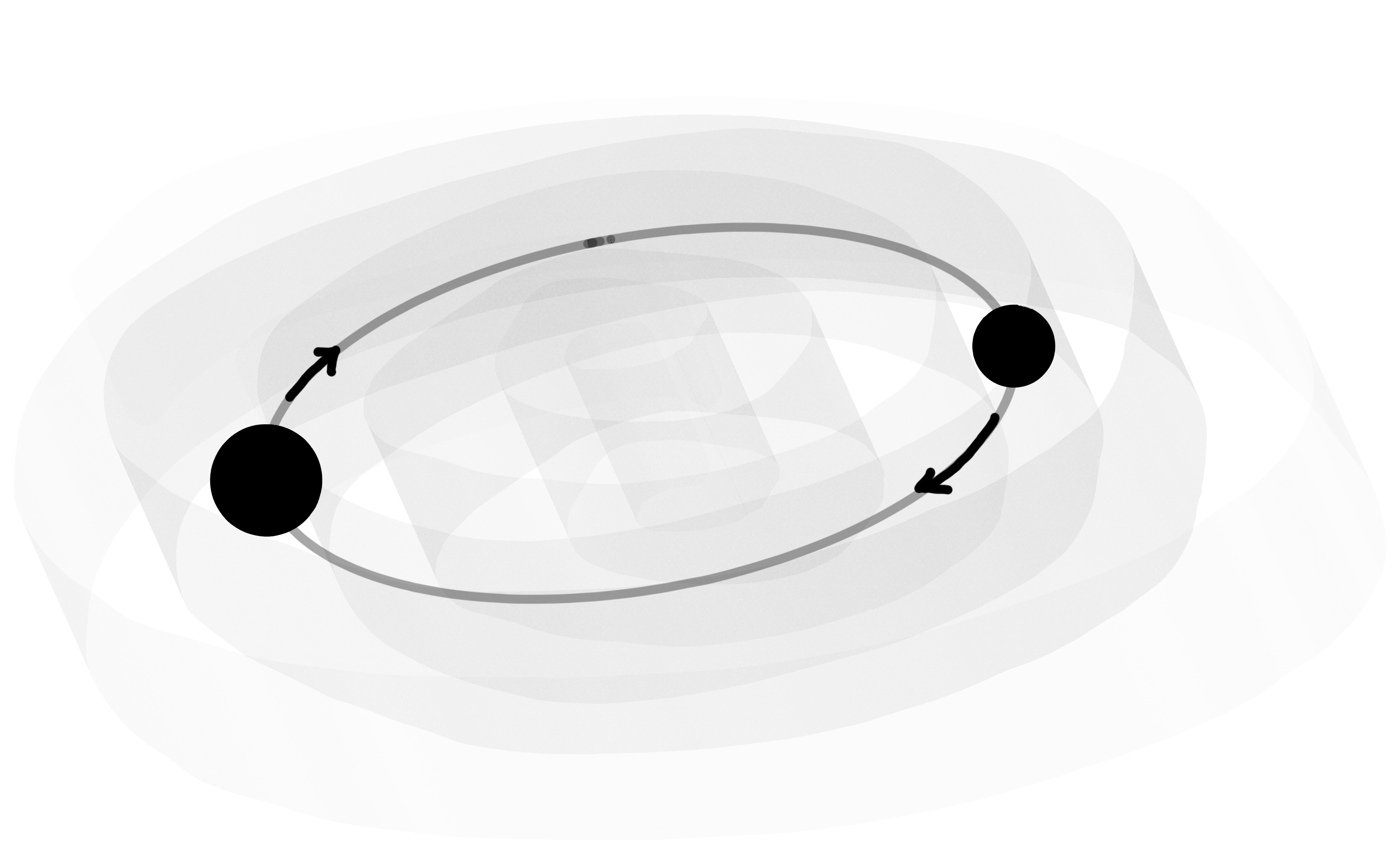
To Leading Order (LO) in \(\texttip{G}{gravitational constant}\) the motion of the binary is described by a Newtonian circular orbit. In barycentric coordinates, such a system is in fact equivalent to effective one body 13 of reduced mass \(\mu=\frac{\texttip{m_{1}}{mass}\texttip{m_{2}}{mass}}{M}\) orbiting in a gravitational potential of mass \(M=\texttip{m_{1}}{mass}+\texttip{m_{2}}{mass}\), at a distance \(R\) equal to the distance between the two bodies forming the binary. The orbit is characterized by a balancing act between the gravitational attraction due to the potential and the centripetal force due to the motion of the reduced mass:14
13 This choice of wording is not a coincidence as we shall see
14 Or equivalently between conserved angular momentum and the derivative of the potential energy.
\[ \frac{\texttip{G}{gravitational constant}M\mu}{(R )^2}=\frac{\mu u_{}^2}{R}, \tag{2.25}\]
where \(u_{}\) is the norm of tangential velocity, and \(R\) is the distance between the two objects. eq. 2.25 gives us the the norm of the velocity
\[ u_{}=\sqrt{\frac{\texttip{G}{gravitational constant}M}{R}}. \]
Thus, the orbital period is simply, in the case of
\[ T=\frac{2\pi R}{u_{}}=2\pi\sqrt{\frac{R^3}{\texttip{G}{gravitational constant}M}}. \]
This also gives us angular frequency:
\[ \Omega=\frac{2\pi}{T}=\sqrt{\frac{\texttip{G}{gravitational constant}M}{R^3}}. \tag{2.26}\]
Thus the EOM \(\texttip{\mathbf{{r}}_{}}{3-vector}(t)\) of the reduced mass is described by a circular orbit in the \(x-y\) plane i.e.:
\[ \texttip{\mathbf{{r}}_{xy}}{3-vector}(t)= \begin{pmatrix} R\cos(\Omega t)\\ R\sin(\Omega t) \end{pmatrix} . \tag{2.27}\]
We have not written the third \(z\) component of the trajectory as that can be set to zero, for a well-chosen set of inertial coordinates. The corresponding trajectory for both masses is simply given by applying the following scaling:
\[ \mu\texttip{\mathbf{{r}}_{}}{3-vector}(t) = \texttip{m_{1}}{mass} \texttip{\mathbf{{r}}_{1}}{3-vector}(t) = \texttip{m_{2}}{mass} \texttip{\mathbf{{r}}_{2}}{3-vector}(t). \]
We can straightforwardly obtain the \(00\) component of the energy-momentum tensor of the system 15 by using the EOM of the reduced mass (eq. 2.27):
15 The energy density is the same for the effective one body system and the two body system.
\[ \texttip{\texttip{\texttip{T}{Stress-Energy tensor, or energy-momentum tensor}{}_{00}}{covariant mathbftor component}}{covariant Stress-Energy tensor component}(t,\texttip{\mathbf{{x}}_{}}{3-vector}) = \mu\texttip{\delta^{{}}(x_3)}{Dirac delta function}\texttip{\delta^{{}}(x_1-R\cos(\Omega t))}{Dirac delta function}\texttip{\delta^{{}}(x_2-R\sin(\Omega t))}{Dirac delta function}, \]
which when plugged into eq. 2.23, gives us the quadrupole moment of the rotating system:
\[ \begin{aligned} I_{11} &= \mu R^2 \cos ^2( \Omega t)= \mu R^2(1+\cos (2 \Omega t)) \\ I_{22} &= \mu R^2 \sin ^2( \Omega t)= \mu R^2(1-\cos (2 \Omega t)) \\ I_{12}=I_{21} &=2 \mu R^2(\cos \Omega t)(\sin \Omega t)= \mu R^2 \sin (2 \Omega t) \\ I_{i 3} &=0 . \end{aligned} \]
Thus, we have roughly:
\[ I_{}\sim \mu R^2 \cos (2 \Omega t) \sim \mu R^2 \sim \mu\Big(\frac{\texttip{G}{gravitational constant}M}{\Omega^2} \Big)^{\frac{2}{3}}= \frac{\texttip{G}{gravitational constant}\texttip{m_{1}}{mass}\texttip{m_{2}}{mass}}{(\texttip{m_{1}}{mass}+\texttip{m_{2}}{mass} )^{\frac{1}{3}}}\Omega^{-\frac{4}{3}}, \]
where we have expanded in small \(R\) in the second relation. The metric perturbation is then given by eq. 2.24 and has norm proportional to:
\[ h \propto \frac{\ddot{I_{}}}{r} \propto \frac{1}{r} \frac{\texttip{G}{gravitational constant}\texttip{m_{1}}{mass}\texttip{m_{2}}{mass}}{(\texttip{m_{1}}{mass}+\texttip{m_{2}}{mass} )^{\frac{1}{3}}}\Omega^{\frac{2}{3}}. \tag{2.28}\]
2.4.2 Black Hole (BH) Binaries
Taking the process described above to the limit of more massive and more compact objects one could imagine asking for the most dense objects possible to orbit each other. In GR this object is called a black hole BH It is a possible solution to the full fat EFE (eq. 2.1), in a static and isotropic universe, with point like mass at its center. Then the solutions to the equations eq. 2.1 have a unique form [3], called the Schwarzschild solution.
The solution is given by, in spherical coordinates:
\[ \,\mathrm{d}^{}\tau^{2}\,=\left[ 1-\frac{R_{S}}{r} \right]\,\mathrm{d}^{}t^{2}\, -\frac{\,\mathrm{d}^{}r^2\,}{1-\frac{R_{S}}{r}}-r^{2}\left(\,\mathrm{d}^{} \theta^2\,+\sin ^{2} \theta \,\mathrm{d}^{} \varphi^2\,\right) \tag{2.29}\]
where \(R_S\) is the Schwarzschild radius, given by:16
16 we reinstate the speed of light, as we want to compute orders of magnitudes
\[ R_S=\frac{2GM}{c^2}. \]
For stellar masses we have \(R_S=2954\; \mathrm{m}\), quite a lot smaller than the radius of the sun \(\sim 7\cdot10^8\; \mathrm{m}\). Note that the metric given in eq. 2.29 exhibits singularities at both \(r=R_S\) and \(r=0\). The former is spurious, as it is an artefact of the coordinate choice, while the latter is real, in the sense that coordinate independent scalars formed from the metric (such as the ricci scalar) do in fact blow up as \(r\to0\). This encodes the non-spurious mass singularity that gives rise to the BH phenomena.
If we consider a comparable stellar mass Binary Black Hole (BBH) system, we can use the calculations of the previous section to compute the order of magnitude of the perturbation. eq. 2.26 in terms of the Schwarzschild radius gives us the orbital frequency
\[ f=\frac{\Omega}{2\pi}=\frac{\texttip{c}{speed of light}}{2\pi}\sqrt{\frac{ R_S}{R^3}}, \]
and the metric perturbation is given by eq. 2.28:
\[ h = \frac{R_S^2}{R}. \]
Thus, if we consider BH separated by ten times their Schwarzschild radius, observed at cosmological distances \(\sim 100 \;\mathrm{Mpc}\), we obtain the values for the scales characterizing the binary system:
\[ \begin{aligned} R_S &\approx 10^3\; \mathrm{m} ,\\ R&\approx 10^4\; \mathrm{m} ,\\ r &\approx 10^{23}\; \mathrm{m}. \end{aligned} \]
Such a system would have an orbital frequency of:
\[ f\approx 10^{2}\; \mathrm{Hz}, \]
and would perturb the metric on earth by:
\[ h\approx 10^{-21}. \]
To have any hope of detecting such systems, one would need to have detectors sensitive to frequency spectra up to hundreds of Hertz, with a strain sensitivity of \(10^{-21}\). This has been achieved at Laser Interferometer Gravitational-Wave Observatory (LIGO) and other detectors, and has enabled the detection of such systems.
Non-spinning black holes orbiting around each other are the simplest binary system to model. However, they are extremely unlikely to occur in nature (realistic physical scenarios). The nature of BH formation implies that they necessarily also spin. Spinning black holes, also referred to as Kerr black holes, are characterized by a different metric tensor defining the spacetime surrounding them. The modelling of spinning black holes is still in its infancy and will not be treated it here.
There are many other binary systems that could feasibly be detected. Finite-size binaries such as Neutron Star (NS) result in tidal phenomena that are not present in the BH case. Also, non-binary systems, such as Cosmic strings, corresponding to early universe topological defects, could produce a detectable stochastic GW background.